Comments Off on The Importance of Grounding: Simple Steps to Reconnect with Your Mind and Body
by dpafa
In a world increasingly disconnected from nature, grounding – the practice of connecting your body directly to the Earth – is more important than ever. As we spend more time indoors, surrounded by technology and artificial surfaces, our bodies are deprived of the Earth’s natural healing energy. This disconnection can lead to a range of physical and mental health issues, including stress, anxiety, inflammation, and sleep disturbances.
Grounding, also known as earthing, offers a simple yet powerful way to restore this vital connection. By making grounding a regular part of your daily routine, you can tap into a range of surprising health benefits that extend far beyond just feeling more connected to the Earth.
What is Grounding?
At its core, grounding involves physically connecting your body to the Earth’s surface. This can be done by walking barefoot on natural surfaces like grass, sand, or soil, or by using specialized grounding devices that bring the Earth’s natural electrical charge indoors. The practice of grounding allows your body to absorb the Earth’s electrons, which can help neutralize harmful free radicals and restore the body’s natural balance.
Grounding is not just a feel-good practice; it’s supported by science. Research has shown that grounding can reduce inflammation, improve sleep quality, lower stress levels, and even support cardiovascular health. In this article, we’ll explore the science behind grounding, the numerous health benefits it offers, and practical techniques for incorporating this ancient practice into your modern lifestyle.
The Science Behind Grounding
The Earth’s surface carries a negative electrical charge, while the human body tends to accumulate positive charges from exposure to electromagnetic fields (EMFs) and other sources of electrical pollution. This electrical imbalance can lead to oxidative stress, inflammation, and a host of other health issues.
Grounding helps to neutralize these positive charges by allowing the body to absorb the Earth’s negative electrons. This process can help reduce inflammation, lower stress, and promote overall well-being. For instance, a study published in the Journal of Alternative and Complementary Medicine found that grounding during sleep reduced nighttime cortisol levels—a stress hormone—and significantly improved sleep quality in participants.
Further research has shown that grounding can also support the autonomic nervous system by promoting a balance between the sympathetic nervous system (responsible for the “fight or flight” response) and the parasympathetic nervous system (responsible for relaxation and healing). This balance is crucial for maintaining overall health and resilience to stress.
The Health Benefits of Grounding
Grounding offers a wide range of health benefits, many of which have been supported by scientific research. Here’s a closer look at some of the key benefits:
1. Reduces Inflammation and Chronic Pain
Inflammation is the body’s natural response to injury or infection, but chronic inflammation can lead to various health issues, including arthritis, diabetes, and cardiovascular disease. Grounding has been shown to reduce inflammation by neutralizing free radicals, which are unstable molecules that can damage cells and contribute to chronic inflammation.
A study published in the Journal of Inflammation Research found that grounding reduced the levels of several inflammatory markers, including white blood cell count and C-reactive protein (CRP). Participants in the study reported significant reductions in pain and stiffness after practicing grounding for just four weeks.
For those suffering from chronic pain conditions like arthritis, grounding can be particularly beneficial. A pilot study on patients with osteoarthritis found that participants who slept on a grounded mat for eight weeks experienced decreased pain and improved physical function.
2. Improves Sleep Quality
Sleep is essential for overall health and well-being, yet many people struggle with sleep disorders or poor sleep quality. Grounding has been shown to regulate the body’s circadian rhythm—the internal process that governs the sleep-wake cycle—by synchronizing it with the Earth’s natural cycles.
One of the reasons grounding improves sleep quality is its impact on melatonin production. Melatonin is a hormone that regulates the sleep-wake cycle and is produced in response to darkness. Grounding has been shown to increase melatonin levels, helping to improve sleep quality and duration.
In a study published in the Journal of Alternative and Complementary Medicine, participants with sleep disturbances who practiced grounding reported falling asleep faster, waking up less during the night, and feeling more refreshed in the morning.
3. Boosts Mood and Reduces Stress
Chronic stress can have a profound impact on physical and mental health, contributing to conditions such as heart disease, depression, and weakened immune function. Grounding has been shown to reduce stress hormones, such as cortisol, and promote feelings of calmness and well-being.
A study published in Psychological Reports found that grounding reduced stress and improved mood in participants. They reported feeling less anxious, depressed, and fatigued after practicing grounding for just one hour. This mood-boosting effect is likely due to grounding’s ability to activate the parasympathetic nervous system, which promotes relaxation and healing.
4. Supports Cardiovascular Health
Cardiovascular disease is a leading cause of death worldwide, and many risk factors, such as high blood pressure and inflammation, can contribute to its development. Grounding has been shown to support cardiovascular health by improving blood flow and reducing blood viscosity, which can lower the risk of blood clots and improve circulation.
In addition, grounding has been shown to increase heart rate variability (HRV), an indicator of autonomic nervous system function and cardiovascular health. Higher HRV is associated with better cardiovascular health and resilience to stress.
5. Enhances Athletic Performance and Recovery
For athletes and fitness enthusiasts, grounding offers a natural way to enhance performance and speed up recovery. Grounding has been shown to reduce muscle damage and inflammation, leading to faster recovery times after intense exercise.
A study published in the Journal of Strength and Conditioning Research found that grounding improved recovery and reduced muscle damage after eccentric exercise. Participants who practiced grounding reported less pain and faster recovery compared to the control group.
Additionally, grounding can help alleviate delayed onset muscle soreness (DOMS)—the pain and stiffness felt in muscles after unaccustomed or strenuous exercise—by reducing inflammation and oxidative stress.
Practical Grounding Techniques for Everyday Life
Incorporating grounding into your daily routine is simple and can provide numerous health benefits. Here are some practical techniques to help you get started:
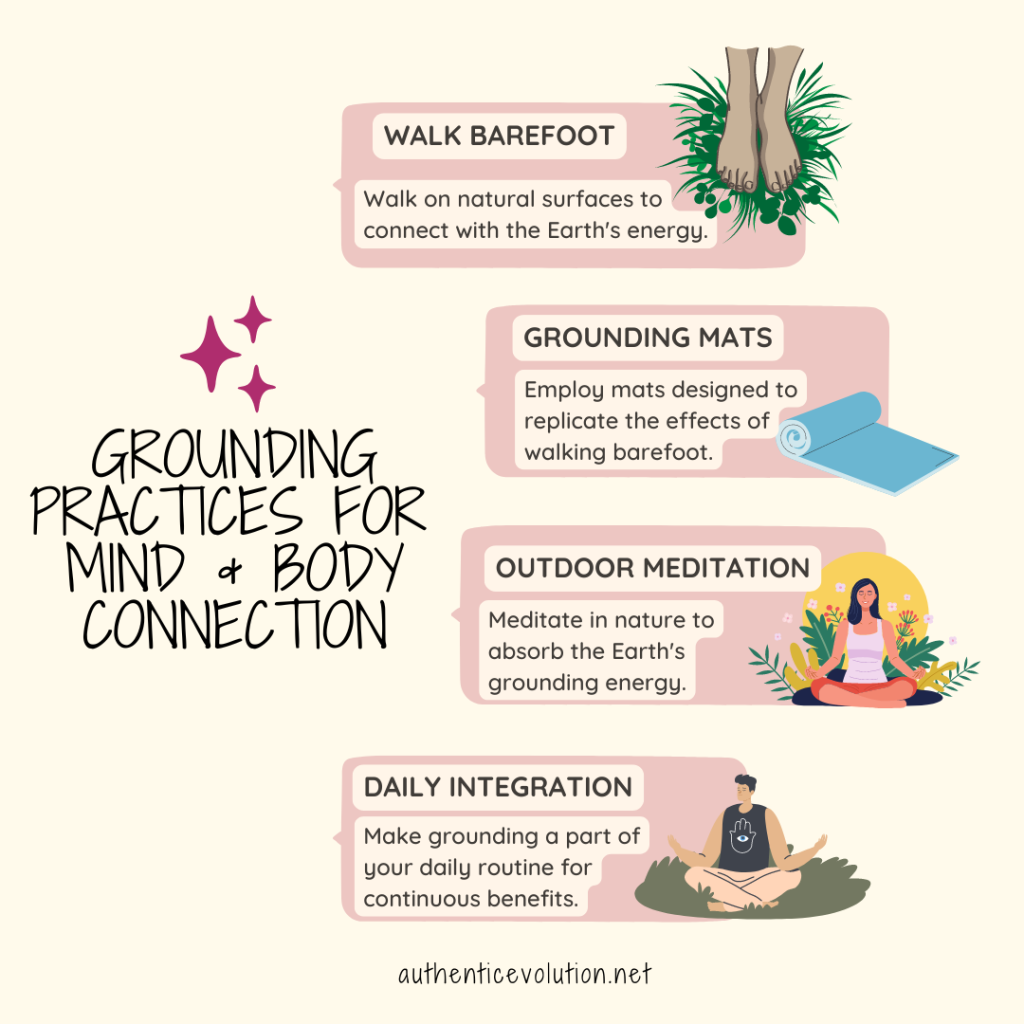
1. Barefoot Walking
Walking barefoot on natural surfaces like grass, sand, or soil is one of the simplest and most effective ways to ground yourself. Aim to walk barefoot for at least 30 minutes a day. Pay attention to the sensations of your feet connecting with the Earth, the texture of the surface, and the temperature of the ground. This mindful approach can enhance the grounding experience and help reduce stress.
If you’re new to barefoot walking, start slowly to allow your feet to adjust. Be mindful of your surroundings and avoid sharp objects or uneven terrain. If walking on rough surfaces, consider using minimalist footwear that allows your feet to maintain contact with the ground.
2. Using Grounding Mats and Sheets
For those who spend most of their day indoors, grounding mats and sheets offer a convenient way to stay connected to the Earth. These products are designed to mimic the effects of direct contact with the ground by using conductive materials that are connected to the Earth via a grounded outlet or a grounding rod.
Place a grounding mat under your feet while sitting at your desk or on the couch, or use a grounding sheet while sleeping. Aim to use these products for at least 30 minutes per session to experience the benefits of grounding.
3. Outdoor Meditation or Yoga
Practicing meditation or yoga outdoors, directly on the ground, is another effective way to ground yourself. Find a quiet spot in nature, such as a park or forest, and sit or stand directly on the grass or soil. Begin your practice by focusing on your breath and the sensation of your body connecting with the Earth. As you move through your session, visualize the Earth’s energy flowing up through your feet and into your body, promoting a sense of calm and balance.
Choose a location that feels safe and peaceful, away from distractions and noise. Use a natural mat, such as a grass mat or a cotton yoga mat, to maintain a connection with the ground. Practicing during the early morning or late afternoon, when the Earth’s energy is most intense, can enhance the grounding experience.
4. Grounding at Work
Even during a busy workday, you can incorporate grounding practices to stay connected with the Earth. Consider using a grounding mat at your desk or taking short breaks to walk barefoot outside. If your workplace has an outdoor area, use it for walking meetings or take your lunch break outside to connect with nature.
5. Grounding at Home
Your home should be a sanctuary where you can relax, recharge, and connect with the Earth. Create a dedicated grounding space in your home, preferably outdoors, where you can regularly practice grounding. This could be a small garden, a balcony, or a corner of your backyard with direct access to natural surfaces like grass or soil.
Enhance this space with comfortable seating, such as a bench or meditation cushions, and add natural elements like plants or a small water feature to create a calming atmosphere. You can also use grounding sheets on your bed to maintain a connection with the Earth throughout the night.
“The Earth has its own energy, and when we connect to it, we align our bodies with its natural rhythms, promoting healing and balance.”— Clinton Ober
The Importance of Grounding in Modern Life
In today’s fast-paced, technology-driven world, grounding provides a simple, accessible, and cost-effective way to support your body’s natural healing processes. Whether you choose to walk barefoot on the Earth, use grounding products, or practice outdoor meditation, making grounding a regular part of your life can have a profound impact on your health.
Make Grounding a Part of Your Daily Routine
Grounding offers a simple yet powerful way to improve your health and well-being. By connecting with the Earth’s natural electrical charge, you can reduce inflammation, improve sleep quality, and boost your mood.
Start small by incorporating a few minutes of grounding into your daily routine. Whether it’s taking a barefoot walk in your backyard or using a grounding mat at work, these small steps can lead to significant improvements in your overall well-being. Embrace the power of nature and make grounding a regular practice in your life.
Further Exploration
If you’re interested in learning more about grounding and its benefits, consider checking out these resources:
“Earthing: The Most Important Health Discovery Ever?” by Clinton Ober, Stephen T. Sinatra, and Martin Zucker
“The Earthing Movie: The Remarkable Science of Grounding” (documentary)
“The Grounded Body: The New Science of Earthing and Its Vital Role in Health and Healing” by Laura Koniver, MD
These resources offer a deeper dive into the science behind grounding and provide practical tips for incorporating it into your life.
You might find this process therapeutic as you tap into and express your repressed shadow self.
So, whether you’re scribbling in a journal or dancing out your feelings, shadow work is all about exploring those hidden parts of yourself and bringing them into the light.
Comments Off on Discovering Your Shadow Self: Proven Techniques for Personal Growth
by dpafa
Unmasking the Shadow Self: 15 Transformative Techniques for Inner Exploration
Do you ever feel disconnected from your true self, grappling with hidden fears, desires, or impulses that contradict your conscious identity? Welcome to the realm of the shadow self—the repressed aspects of your psyche that hold the key to profound personal growth and self-acceptance.
In this guide, we’ll explore 15 transformative techniques to confront, heal, and integrate the darkest parts of ourselves. From uncovering childhood wounds to embracing creative self-expression, these practices will challenge you to face your shadows head-on and unlock your untapped potential.
Ready to peel back the layers of your psyche and discover the authentic self that lies beneath? Let’s dive in.
Confront Your Shadow Self with These Powerful Inner Work Techniques
Begin by uncovering hidden aspects of your personality through self-reflection and journaling. Identify emotional triggers and patterns to gain deeper self-awareness. Consider working with a therapist or coach specializing in Jungian psychology for expert guidance.
Identify Your Emotional Triggers
A crucial step in confronting your shadow self is becoming aware of your emotional triggers—people, situations, or events that provoke intense emotional reactions, such as anger, jealousy, shame, or fear. By observing your reactivity patterns, you can recognize the aspects of yourself that you tend to suppress or hide.
Journaling Prompts for Uncovering Emotional Triggers:
What situations or people tend to provoke strong emotional reactions in me?
When I feel triggered, what thoughts and beliefs arise?
What aspects of myself do I tend to suppress or hide when I’m triggered?
Practice Self-Reflection Exercises
Engaging in regular self-reflection helps you confront your shadow self. Set aside time for introspection and self-inquiry. Ask yourself tough questions about your beliefs, values, and behaviors. Explore parts of yourself that you may have disowned or rejected.
Guided Meditations for Shadow Work
Use guided meditations or visualizations focusing on shadow work or inner child healing. These meditations often involve dialoguing with different aspects of yourself, such as your inner critic or wounded inner child. This safe, imaginative space allows valuable insights and starts the process of integration.
Work with a Therapist or Coach Specializing in Jungian Psychology
While self-guided shadow work is possible, working with a trained professional provides invaluable support and guidance. A therapist or coach specializing in Jungian psychology can help you uncover and integrate your shadow aspects, using techniques like dream analysis, active imagination, or role-playing.
Heal Your Inner Child to Transform Your Shadow Self
Identify Your Childhood Wounds and Unmet Needs
Reflect on your early experiences to heal your inner child and transform your shadow self. Explore how childhood shaped your beliefs, behaviors, and patterns, and consider any unmet emotional needs. Recognizing these unresolved wounds is essential for shadow work, allowing you to integrate them healthily.
Practice Reparenting and Self-Compassion
Once you’ve identified your childhood wounds, offer yourself the love and support you needed as a child. Reparenting involves treating yourself with kindness, understanding, and validation. Engage in nurturing activities like self-care, play, and creative expression to reconnect with your inner child.
Develop self-compassion by speaking to yourself as you would a dear friend. When feelings of shame, guilt, or self-criticism arise, meet them with gentleness and understanding. Remember that your inner child is not to blame for past hurts or current struggles.
Use Inner Child Healing Visualizations and Meditations
Visualization and meditation are powerful tools for inner child work. Find a quiet space, relax, and turn your attention inward. Imagine yourself as a child, at an age when you felt particularly vulnerable. Engage in a dialogue with your inner child, offering reassurance and creating a safe, nurturing space.
“To confront the shadow is to confront the truth of who we are—both the light and the dark—so that we may live as our most authentic selves.”
— Danielle Aime
Embrace Your Shadow Through Creative Self-Expression
Creative self-expression provides a powerful avenue for exploring and integrating your shadow self. Through art therapy, journaling, and role-playing techniques, you can tap into hidden aspects of your psyche and bring them into the light of awareness.
Use Art Therapy Techniques to Explore Your Shadow
Art therapy offers a non-verbal way to express and process emotions, fears, and desires that may lurk in your shadow. Create visual representations of your inner world to gain new insights and perspectives on the parts of yourself you may have been avoiding or denying.
Art Therapy Techniques:
Draw, paint, or sculpt images representing your shadow aspects. Allow yourself to create freely, without judgment or self-censorship.
Create a collage of images that evoke your hidden desires, fears, and impulses. Reflect on any themes or patterns that emerge.
Write poetry or stories that give voice to your shadow self, allowing it to express itself fully.
Shadow Work Journaling Prompts:
What qualities or traits do I most judge or criticize in others? How might these reflect my shadow self?
What desires or impulses am I most ashamed or afraid of? How can I explore these safely and healthily?
What parts of myself have I been neglecting or denying? How can I give them a voice and incorporate them into my life?
Use Role-Playing or Drama Therapy to Embody Your Shadow
Role-playing and drama therapy allow you to physically embody and explore your shadow aspects in a safe environment. By taking on the role of your shadow self, you can gain a deeper understanding of its underlying emotions, motivations, and needs.
Drama Therapy Techniques:
Take on the role of your shadow in a private, supportive space. Notice how it feels to embody this aspect of yourself.
Engage in dialogues or improvisations with your shadow character, allowing each part to express its perspective.
Explore the emotions, motivations, and needs underlying your shadow behaviors.
Harness the Power of Your Shadow for Personal Growth
Acknowledge and Accept Your Shadow Aspects Without Judgment
Recognize that your shadow is a natural part of your psyche, made up of traits, desires, or emotions you may have repressed or denied. Approach your shadow with curiosity and openness rather than fear or resistance.
Find Healthy Outlets for Expressing Your Shadow Energies
Once you’ve acknowledged your shadow aspects, find healthy ways to express and integrate these energies into your life. Channel your shadow into constructive activities like exercise, art, or activism. Practice setting boundaries and assertiveness to express your needs and desires.
Cultivate a Growth Mindset Around Your Shadow Work
View your shadow as an opportunity for learning and transformation. Embrace the lessons it offers and celebrate the progress and insights gained through inner work.
“Embracing the shadow within us is not about dwelling in darkness, but about illuminating the hidden corners of our psyche to reveal the full spectrum of our humanity.”
— Danielle Aime
Common Misconceptions About Shadow Work
Shadow Work Is Not About Indulging in Negativity: The true purpose of shadow work is to acknowledge and integrate hidden aspects of ourselves, not to dwell on them excessively.
Perfection Is Not the Goal of Shadow Work: The goal is not to eliminate shadow aspects but to integrate them healthily and balanced.
Shadow Work Requires Deep Introspection: Genuine shadow work involves deep introspection and a willingness to confront uncomfortable truths about ourselves.
The Key to Integrating Your Shadow
Ultimately, shadow work and integrating your shadow come down to one primary thing: acceptance. Can you accept the reality of the insights that arise through inner work? Acceptance leads to greater psychological maturity and a more fluid life.
By helping dismantle the false self, shadow work paves the way to bring you closer to your true self.
Embracing Your Wholeness Through Shadow Work
Shadow work is an ongoing journey of self-acceptance and integration. Be patient and compassionate with yourself as you explore the depths of your psyche.
What one small step can you take today to start embracing your shadow? Whether it’s self-reflection, reaching out to a therapist, or expressing your feelings through art, trust that engaging in this transformative work cultivates greater wholeness, resilience, and authenticity in all areas of your life.
Are negative thoughts and limiting beliefs keeping you stuck?
Imagine if you could rewire your brain for positive change and manifest the life you’ve always desired.
Affirmations offer a powerful way to reshape your mindset, bringing your dreams into reality. By tapping into the brain’s natural ability to change, known as neuroplasticity, you can create lasting shifts in your thoughts, beliefs, and, ultimately, your reality.
In this article, we’ll explore the science of affirmations, guide you on how to craft impactful statements, and introduce you to 7 transformative affirmations to help you manifest a more positive and fulfilling life.
Rewiring Your Brain with Affirmations: How to Create Positive Change and Manifestation
Understanding the Power of Neuroplasticity
Neuroplasticity is the brain’s incredible ability to form new connections and adapt to new experiences. This means that your thoughts and beliefs can literally reshape your brain over time. By consistently reinforcing positive thoughts through affirmations, you can rewire your brain to support not just positive change but also the manifestation of your deepest desires.
Research supports that the brain can form new neural pathways well into adulthood. For example, a study published in *Nature Communications* found significant brain changes in adults who practiced a new skill for just two weeks, highlighting the profound impact of neuroplasticity. When you align your affirmations with your manifestation goals, you are actively guiding your brain to create the reality you envision.
The Role of Consistent Practice in Manifestation
Rewiring your brain with affirmations requires consistent practice. Just like learning a new skill, repetition is key to creating lasting change. By regularly repeating affirmations, especially those focused on manifestation, you strengthen the neural pathways associated with positive thoughts, making them more automatic and ingrained in your mindset.
Experts like Charles Duhigg in *The Power of Habit* and James Clear in *Atomic Habits* emphasize the importance of consistency in building habits. Similarly, Norman Doidge in *The Brain That Changes Itself* illustrates the brain’s capacity to reorganize itself through new experiences and learning. Consistently focusing your affirmations on what you want to manifest helps create a strong mental foundation for attracting those outcomes into your life.
Incorporating Affirmations into Your Daily Manifestation Routine
To fully benefit from affirmations and to aid in manifestation, it’s crucial to make them a consistent part of your daily life. Choose a quiet time and space where you can focus on your affirmations without distractions. Many find practicing affirmations first thing in the morning or just before bed most effective, as these times are when your mind is most receptive to new ideas.
Pairing Affirmations with Visualization for Manifestation
Enhance the power of your affirmations by pairing them with visualization, a key component in manifestation practices. As you repeat each affirmation, visualize yourself embodying the qualities or achieving the goals you’re affirming. Engage all your senses in this process, making the visualization as vivid and realistic as possible. This not only deepens your emotional connection to the affirmation but also accelerates the manifestation process, as your brain begins to see these outcomes as achievable realities.
Optimal Frequency and Duration for Manifesting Your Desires
For best results, repeat your affirmations multiple times a day. Aim for 10-15 repetitions per session, focusing on the feeling and belief behind each word. Consistency matters more than length, so even a few minutes a day can lead to significant positive change and powerful manifestations over time.
Here’s a sample daily affirmations routine focused on manifestation:
| Time of Day | Affirmation Practice | | Morning | 10-15 repetitions of each affirmation, paired with visualization | | Midday | 5-10 repetitions of each affirmation, focusing on feeling and belief | | Evening | 10-15 repetitions of each affirmation, reflecting on progress and gratitude |
By harnessing the power of neuroplasticity and making affirmations a daily practice, you can rewire your brain for positive change and begin to manifest the life you desire. As you continue to practice, you’ll notice shifts in your thoughts, emotions, and behaviors, aligning more closely with the reality you wish to create.
The power to create your reality lies in the belief that it’s already yours.
— Danielle Aime
The Science Behind Affirmations: How They Work for Positive Change and Manifestation
The Role of Self-Talk in Shaping Beliefs and Manifestation
Your inner dialogue plays a crucial role in shaping your beliefs, perceptions, and ultimately, what you manifest in your life. Negative self-talk reinforces limiting beliefs, while positive self-talk through affirmations can counteract these patterns and pave the way for manifestation. By consciously choosing to repeat positive statements, you start to reframe your perspective and boost self-confidence, making it easier to manifest your goals.
The Power of Neuroplasticity in Manifestation
Neuroplasticity supports the effectiveness of affirmations, especially when used with the intent of manifestation. By consistently engaging in positive self-talk, you create new neural pathways that grow stronger over time, similar to how muscles build with exercise. The more you practice affirmations focused on manifestation, the more automatic and powerful these positive thought patterns become, making it easier for you to attract your desires into reality.
The Psychological and Physiological Effects of Affirmations
Affirmations not only uplift your mental state but also have measurable effects on your body, which are crucial for successful manifestation. Positive self-talk activates the brain’s reward centers, releasing feel-good hormones like dopamine and serotonin. This can reduce stress, improve sleep, and enhance overall well-being—creating the perfect internal environment for manifesting your dreams.
The Science of Self-Affirmation Theory and Manifestation
Self-affirmation theory, developed by Claude Steele, suggests that affirmations help maintain self-integrity, making it easier to handle stress and challenges. Research has shown that self-affirmation can improve problem-solving abilities and increase receptivity to positive information, making it a powerful tool for personal growth and manifestation.
Crafting Effective Affirmations for Success and Manifestation
Key Elements of a Powerful Affirmation for Manifestation
Effective affirmations go beyond mere positive thinking. To fully harness their potential for manifestation, affirmations should be present-tense, specific, and emotionally charged.
Use Present Tense and Positive Language for Manifestation
Affirmations should be stated as if your desired outcome is already a reality, which helps your subconscious mind accept it as truth. This is particularly important in manifestation, where belief in your ability to achieve your desires is key. Focus on positive statements to direct your mind toward what you want to manifest, rather than what you don’t.
Make Affirmations Specific and Emotionally Charged for Manifestation
Vague affirmations lack the power to create lasting change or to manifest specific outcomes. Make them specific to your goals, and infuse them with emotion. The more emotionally charged your affirmations are, the more deeply they’ll resonate with your subconscious and support your manifestation efforts.
Ensure Affirmations Align with Your Core Values and Manifestation Goals
For affirmations to be effective in manifestation, they must align with your core values. When affirmations conflict with deeply held beliefs, they can create internal resistance. Reflect on what truly matters to you and craft affirmations that support your authentic self and your manifestation goals.
Personalizing Affirmations for Maximum Impact in Manifestation
Tailor your affirmations to your specific needs to amplify their effectiveness, particularly in manifestation. Craft affirmations that resonate with your unique situation, and adjust them as your goals and circumstances evolve.
Incorporating Affirmations into Your Daily Manifestation Routine
To make affirmations a powerful tool for positive change and manifestation, integrate them into your daily routine. Set aside time each day, write them down, say them aloud, and combine them with visualization for a more impactful experience.
Embrace the Power Within: Affirmations for a Transformed and Manifested Life
Affirmations are more than just positive statements—they’re a pathway to rewiring your brain for positive change and manifesting your dreams. By consistently practicing affirmations with intention, you can reshape your thoughts, beliefs, and reality.
Make affirmations a non-negotiable part of your self-care routine. Combine them with meditation, mindfulness, and journaling to deepen their impact and enhance your manifestation efforts. Start today by choosing an affirmation that resonates with you and commit to repeating it daily for the next 30 days. Notice how your mindset, emotions, and experiences shift as you consistently affirm and manifest your desired reality.
The power to create positive change and manifest your dreams lies within you. Embrace your inner strength, trust the process, and watch as your life unfolds in beautiful and unexpected ways.
Intuition goes beyond just a gut feeling – it’s a transformative tool for personal growth. Over my 15 years of coaching, I’ve seen how nurturing intuition leads to breakthroughs in self-awareness, decision-making, and overall life satisfaction.
In this article, we’ll explore:
The key benefits of honing your intuition
Proven strategies to strengthen your intuitive skills
Real-life stories of intuition-led transformations
The fascinating science behind intuitive insights
Practical tips for cultivating an intuitive lifestyle
Whether you’re experienced or just beginning to tap into your inner wisdom, this guide will provide the knowledge and tools to harness the power of intuition for lasting personal evolution.
Ready to trust your gut and unlock your full potential? Let’s dive in.
Understanding Intuition in Personal Growth
Intuition is often described as an inner knowing or gut feeling that guides our decision-making process. It’s a powerful tool that can help us navigate the complexities of personal growth and self-improvement. When we tap into our intuition, we access a deeper level of wisdom that goes beyond rational thinking.
In personal development, intuition acts as an internal compass, helping us align our choices with our values and goals. By listening to our intuitive promptings, we can make decisions that feel authentic and true to ourselves. This inner guidance system complements our logical reasoning, providing a holistic approach to self-improvement.
The Role of Self-Awareness in Developing Intuition
Cultivating self-awareness is crucial for strengthening our intuitive abilities. As we become more attuned to our thoughts, emotions, and bodily sensations, we can better discern the subtle messages our intuition sends us. Regular practices like mindfulness meditation, journaling, and self-reflection can help us develop a keener sense of self-awareness and, in turn, enhance our intuitive skills.
Key Benefits of Honing Intuition for Self-Improvement
When we learn to trust and follow our intuition, we experience numerous benefits in our personal growth journey:
Enhanced self-trust and confidence: By consistently making choices that align with our intuitive guidance, we build greater trust in ourselves and our abilities. This increased self-confidence allows us to tackle challenges with more ease and grace.
Aligned decision-making: Intuition helps us make decisions that support our values, passions, and long-term goals. When we listen to our inner wisdom, we’re more likely to choose paths that lead to fulfillment and satisfaction.
Improved problem-solving skills: Intuitive insights often arise when we’re faced with complex problems or uncertainties. By tapping into our intuition, we can access creative solutions and novel perspectives that our rational mind might overlook.
Navigating Life’s Challenges with Intuitive Wisdom
Life inevitably presents us with obstacles and difficult decisions. In these moments, our intuition can be a powerful ally, helping us navigate the unknown with greater clarity and confidence. By trusting our gut instincts, we can more easily identify the best course of action, even in the face of uncertainty.
However, it’s important to balance intuitive promptings with rational analysis and factual information. By integrating both intuitive and logical approaches, we can make well-rounded decisions that support our overall well-being and growth.
Strategies for Developing and Trusting Intuition
Practice mindfulness and self-reflection: Regularly engage in activities that promote self-awareness, such as meditation, journaling, or contemplative practices. By turning inward and observing our thoughts and feelings without judgment, we create space for intuitive insights to emerge.
Pay attention to bodily sensations: Our intuition often communicates through physical cues, such as gut feelings, goosebumps, or a sense of unease. Learn to recognize and interpret these bodily signals as potential intuitive messages.
Cultivate a growth mindset: Embrace challenges and view mistakes as opportunities for learning and growth. A growth mindset allows us to take risks and trust our intuition, even when the outcome is uncertain.
Seek out diverse experiences and perspectives: Expose yourself to new ideas, cultures, and viewpoints. Engaging with diverse perspectives can help expand your intuitive capacity and provide fresh insights into your personal growth journey.
“Trusting your intuition is like unlocking a secret map to your true self, guiding you through the complexities of life with clarity and confidence. Embrace your inner wisdom and watch as your life transforms.”
— Danielle Aime
Real-Life Examples of Intuition-Led Breakthroughs
Throughout my 15 years as a personal development coach, I’ve witnessed countless instances where clients have experienced significant breakthroughs by trusting their intuition. One memorable case involved a client who had been stuck in an unfulfilling career for years. Despite their initial hesitation, they decided to follow their gut instinct and pursue a passion for teaching. This decision led them to a rewarding career change that not only provided a sense of purpose but also improved their overall well-being.
Another striking example is that of an individual who had been struggling with a pattern of unsatisfying relationships. By learning to trust their intuition, they were able to identify and break free from a cycle of unhealthy partnerships. This client’s newfound trust in their instincts ultimately guided them towards a transformative, loving relationship that supported their personal growth.
In the realm of education, I recall a student who was torn between two seemingly promising academic paths. After deep introspection and learning to listen to their inner voice, they chose a field of study that truly resonated with their values and interests. This intuition-led decision set them on an enriching educational journey that unlocked their full potential and led to a successful career.
One of the most significant obstacles I’ve observed in coaching clients is the fear of making the wrong decision. Many individuals struggle with self-doubt and second-guessing their intuitive promptings. To overcome this, I encourage clients to practice self-compassion and learn to trust themselves. By acknowledging that mistakes are a natural part of the growth process, they can gradually build confidence in their intuitive abilities.
Another common hurdle is the influence of external expectations and societal pressures. Clients often find it challenging to differentiate between their own intuitive guidance and the opinions of others. To address this, I guide them through exercises that help them reconnect with their authentic selves and develop a stronger sense of inner knowing. This may involve techniques such as mindfulness, journaling, or visualization practices.
How Developing Intuition Accelerates Personal Development
As clients strengthen their intuitive abilities, they often experience a ripple effect that extends to various aspects of their lives. Trusting their instincts leads to greater self-awareness, enabling them to identify and address limiting beliefs and patterns that may have been holding them back.
Moreover, intuitive decision-making empowers individuals to take ownership of their lives and actively shape their destinies. By aligning their choices with their deepest values and aspirations, they experience a greater sense of fulfillment and purpose. This, in turn, fuels their motivation and resilience in the face of challenges.
Developing intuition also enhances problem-solving skills and adaptability. When faced with complex situations, intuitive individuals can tap into their inner wisdom to navigate uncertainty and find creative solutions. This agility is particularly valuable in today’s rapidly changing world, where the ability to trust one’s instincts can be a significant advantage.
Practical Exercises to Strengthen Intuition
Setting Intuitive Intentions and Tracking Their Manifestation: Each morning, set an intention to connect with your intuition throughout the day. This could be as simple as “I am open to receiving intuitive guidance today.” Keep a journal nearby to record any intuitive insights or hunches that arise. At the end of the day, reflect on how your intuition manifested and any actions you took as a result.
Practicing Embodied Intuition Through Movement and Somatic Awareness: Intuition often communicates through physical sensations and emotions. By tuning into your body’s wisdom, you can access deeper intuitive insights. Engage in practices like yoga, dance, or mindful walking, focusing on the sensations and emotions that arise. Notice any areas of tension or relaxation, and allow your body to guide you towards intuitive truths.
Exploring Intuitive Tools Like Oracle Cards, Dream Work, and Synchronicity: Intuitive tools can provide additional guidance and support on your journey. Oracle cards offer intuitive messages and symbolism, while dream work allows you to tap into your subconscious wisdom. Pay attention to synchronicities – meaningful coincidences that offer intuitive guidance. Keep a dream journal and record any significant symbols or messages that emerge.
Balancing Intuition with Critical Thinking
While intuition is a valuable tool for personal growth, it’s essential to balance gut instincts with critical thinking. Using intuition as a starting point for exploration allows individuals to identify potential paths forward, but it’s crucial to gather data and facts to validate or refine these initial hunches. By iterating between intuitive insights and analytical reasoning, individuals can make well-informed decisions that align with their goals and values. This process involves gathering relevant information, considering multiple perspectives, and weighing the pros and cons of different options.
Nurturing Intuitive Relationships and Communities
Surrounding yourself with individuals who value and nurture intuitive wisdom is crucial for cultivating an intuitive lifestyle. Seek out mentors, coaches, or allies who have experience in developing their intuition and can offer guidance and support. Engage in conversations that explore the role of intuition in personal and professional life, and learn from their insights and experiences.
Collaborate with others who share your interest in intuitive development. Participate in workshops, retreats, or online communities where you can connect with like-minded individuals. Engage in intuitive exercises and practices together, such as group meditations, intuitive journaling, or creative activities that foster intuitive expression. By co-creating with others, you expand your intuitive abilities and gain new perspectives.
Embracing Your Inner Compass for Lifelong Growth
Intuition is a powerful tool that can guide us towards personal evolution and fulfillment. By learning to trust our gut instincts, we can make decisions that align with our true values and goals. Developing intuitive skills through practices like mindfulness, journaling, and seeking new experiences can enhance our self-awareness and confidence.
Integrating intuition into your daily life can lead to transformative breakthroughs, as demonstrated by real-life examples of individuals who followed their intuitive guidance to pursue meaningful careers, relationships, and educational paths. The science behind intuition reveals that it draws on subconscious pattern recognition and interacts with analytical thinking in the brain.
To cultivate an intuitive lifestyle, start by incorporating practices that allow you to tune into your inner wisdom, such as morning rituals, self-care routines, and downtime for reflection. Surround yourself with supportive mentors and communities that value intuitive insights and foster growth-oriented collaborations.
Take a moment to reflect on your current intuitive capacity. When have you followed your instincts and experienced positive outcomes? In what areas of life could you benefit from trusting your gut more? Consider setting intuitive intentions, exploring embodied practices, and engaging with tools like oracle cards or dream work to deepen your connection to your inner guidance.
What’s one small step you can take today to start honoring your intuition more fully? Maybe it’s pausing to listen to your gut feeling when making a decision or carving out time for a mindful activity that allows your intuitive insights to surface. Trust that your intuition is always leading you towards your highest growth and well-being.
TL;DR: Shadow work is one of the rawest, realest paths of self-healing. This blog breaks down what it actually is (without the fluff), how to approach it in a grounded way, and gives you 111 deep, soul-stirring prompts to start unearthing what’s been buried inside. Whether you’re new to shadow work or ready to go deeper, this is for the version of you that’s done pretending and ready to meet your truth.
First of all, we’re not talking about Halloween, the dead of night, or something evil. That is exactly what shadow work IS NOT. And before I give you prompts with no context, I want to teach you the gift it can bring to your life.
If you are reading this, something inside you wants more, knows there’s more, and wants to help you create what I call your Uniqucorn Life™—aka your ideal life, both internally and externally.
So, are you ready to face your shadows and go on a journey of self-discovery? I promise you can do this.
Shadowwork is a powerful tool for inner healing, allowing you to explore the hidden aspects of your psyche and open up to your authentic self. It’s not about diving into something spooky or sinister; it’s about uncovering the parts of yourself that you’ve hidden away, often because of fear or shame.
With over 111 prompts, this ultimate shadow work toolkit is designed to guide you through the process of uncovering your deepest fears, shame, and limiting beliefs. By diving into your unconscious mind and confronting your shadows head-on, you’ll cultivate greater self-awareness, emotional resilience, and personal growth.
Whether you’re new to shadow work or a seasoned practitioner, these prompts will help you navigate your complex inner world, fostering healing, integration, and wholeness. Prepare to unlock the power of shadow work and transform your life.
Understanding Shadow Work
What is shadow work and how does it contribute to my journey?
Shadow work is a transformative practice that allows you to explore and integrate the hidden or repressed parts of your psyche. Often, these are traits and memories that have been buried within your unconscious mind. Carl Jung, a well known psychologist, introduced the concept of the shadow self. Engaging in this deep exploration can lead to significant personal growth and healing by helping you uncover and reconcile shadow traits and emotions that you have suppressed. Embracing your entire self is essential for self-awareness and helps foster self-love.
The concept of the “shadow” in psychology
The concept of the “shadow” was first introduced by Swiss psychiatrist Carl Jung in the early 20th century. According to Jung, the shadow represents the unconscious, repressed aspects of the self that we hide from others and even from ourselves. These aspects can include negative traits, such as anger, jealousy, and shame, as well as positive qualities that we may feel uncomfortable expressing, such as creativity, assertiveness, and sexuality.
Jung believed that everyone possesses a shadow, and that it is a natural part of the human psyche. However, when we deny or suppress our shadow, it can lead to psychological issues, such as anxiety, depression, and self-sabotaging behaviors. By acknowledging and integrating our shadow, we can achieve greater wholeness, authenticity, and emotional well-being.
Alright, enough with the textbook stuff—🥱.
The shadow in literature and popular culture
Let’s talk about the shadow in literature and popular culture because, trust me, it’s everywhere!
In Robert Louis Stevenson’s classic novel The Strange Case of Dr. Jekyll and Mr. Hyde, our buddy Dr. Jekyll has a bit of a problem. His shadow self, Mr. Hyde, is not just a minor inconvenience—he’s a full-blown villain! Mr. Hyde personifies all the dark, repressed desires that the upstanding Dr. Jekyll keeps under wraps. It’s like having an evil twin who takes over whenever you’re not looking.
Now, let’s jump to a galaxy far, far away with Star Wars. Here, we have Darth Vader and Kylo Ren, who totally rock the shadow archetype. These guys are the poster children for inner darkness, constantly wrestling with their dark sides. Darth Vader? He’s got a whole redemption arc that screams shadow integration. And Kylo Ren? Well, he’s practically the definition of conflicted, caught between the light and the dark in a way that makes for some seriously dramatic storytelling.
So, whether it’s Victorian literature or epic space sagas, the shadow is a concept that writers and creators love to explore. It’s all about those juicy, hidden parts of ourselves that make for the best stories and the most compelling characters.
The purpose of shadow work
Shadow work is about shining a light on those parts of ourselves we’ve shoved into the dark corners of our minds. It’s not always pretty, and it can be downright uncomfortable, but it’s also incredibly liberating. When we stop running from our shadows and start facing them, we open up to a whole new level of self-awareness and self-love.
So, think of shadow work as a deep-cleaning session for your soul. You’re digging out all the hidden gunk, giving it a good look, and deciding what needs to stay and what can finally be let go. And guess what? You’re going to come out the other side feeling more whole, more authentic, and way more in tune with who you really are.
The Benefits of Shadow Work
Increased self-awareness and self-acceptance
One of the best perks of shadow work is getting to know yourself on a whole new level. It’s like shining a spotlight on all the bits and pieces of you that you might have shoved into the shadows. By diving into exercises like journaling, meditation, and dream analysis, you can start to see those unconscious thoughts, beliefs, and behaviors that have been quietly running the show.
When you bring these hidden parts into the light, you can start integrating them into your sense of self instead of pretending they don’t exist. This self-acceptance journey helps you embrace your whole self—strengths, weaknesses, and all. It’s about becoming the real, unfiltered you. 🎭
Emotional healing and growth
Shadow work isn’t just about self-awareness; it’s a ticket to emotional healing and growth. We all carry some emotional baggage from past experiences, which can show up as limiting beliefs, self-sabotaging behaviors, and tricky relationship patterns.
By engaging in techniques like inner child work, you can give those neglected or wounded parts of yourself the love and attention they deserve. This process helps release repressed emotions and heals old wounds. Plus, by identifying and challenging those limiting beliefs, you can develop a more empowering mindset that propels you towards your full potential.
Improved relationships and communication
Believe it or not, shadow work can do wonders for your relationships and communication skills. As you understand your own triggers, patterns, and emotional responses better, you become more self-aware and mindful in your interactions with others.
This heightened awareness helps you express your needs and set boundaries more effectively. You’ll also find yourself developing greater empathy and compassion for others because you’ll recognize that everyone has their own set of emotional struggles and wounds. 💞
When you accept and integrate your shadow aspects, you become more accepting of others’ imperfections and vulnerabilities. This leads to more authentic and meaningful connections, as your relationships are built on a foundation of mutual understanding and acceptance. So, get ready to make those connections deeper and more genuine!
“The shadow is a moral problem that challenges the whole ego-personality, for no one can become conscious of the shadow without considerable moral effort. To become conscious of it involves recognizing the dark aspects of the personality as present and real.”
— Carl Jung
How do I Start With Shadow Work Prompts for beginners?
Identify and work with resistance
Getting started with shadow work can seem like diving into the deep end of a pool, but don’t worry—I’ll be your lifeguard! 🌊 Start with some beginner-friendly shadow work prompts. These prompts are simpler and more approachable, giving you a gentle nudge into the deeper aspects of your subconscious and unconscious mind. Regularly engaging with these shadow work journal prompts helps you build a habit of introspective journaling and lays a solid foundation for more advanced exploration.
Look shadow work is not easy. It involves facing some dark parts of your past and inner psyche.
But guess what?
Resistance is totally normal.
So, be kind to yourself! Grace 🫶🏼
Here are a few tips to help you navigate this process:
Pay attention to your triggers: As you process memories, you might get hit by feelings of shame. Note the things that trigger you and bring up feelings in your body.
Pay attention to the feelings in your body: Are you tense? Is your heart rate high? These sensations tell you something about your emotions.
Take deep breaths as you process painful memories: Some feelings that surface might be tough. Breathe through it and speak to yourself with compassion.
Take note of thought patterns and habits that repeat themselves: As you journal through the shadow work prompts, you may notice common themes.
Create a safe and supportive space for shadow work
Since shadow work can be pretty intense, especially if you’ve experienced trauma, it’s essential to do this work in a safe and supportive space.
Many people find safety in doing this work solo with a journal. But if you struggle with negative self-talk, solo might not be so safe after all. In that case, the best thing you can do is to go through this process with a safe friend, professional counselor, or therapist. They can help keep things from getting too overwhelming. 🛋️
Express yourself creatively
Who says shadow work prompts need to be confined to a journal? Not me! If you’re an artist, musician, dancer, or poet, use these prompts to paint, write a song, choreograph, or express your feelings creatively. 🎨🎶💃🖋️
You might find this process therapeutic as you tap into and express your repressed shadow self.
So, whether you’re scribbling in a journal or dancing out your feelings, shadow work is all about exploring those hidden parts of yourself and bringing them into the light.
Ready to dive deep into your mind? Let’s grab that journal and get to work! Here’s how you can start exploring your fears, shame, and limiting beliefs.
Exploring your fears, shame, and limiting beliefs
First things first, set aside some dedicated time for journaling—aim for at least 20-30 minutes per session. Find a quiet, comfy spot where you won’t be disturbed. Now, start writing about your fears, the things that make you feel ashamed, and the beliefs that hold you back in life. Don’t hold back—let your thoughts and feelings flow onto the page without judgment.
Identifying patterns and triggers in your life
As you journal, keep an eye out for recurring themes and patterns in your experiences. 🔍 What situations or people tend to trigger those negative emotions or self-defeating behaviors? By pinpointing these triggers, you can boost your self-awareness and learn to react differently in challenging moments.
Examining your relationships and attachment styles
Our early experiences with caregivers shape our attachment styles and relationship patterns throughout life. Use journaling prompts to dig into your family dynamics, romantic relationships, and friendships. Do you notice any patterns of codependency, avoidance, or anxiety in your connections with others? This awareness can help you cultivate healthier, more secure attachments.
Emotional Healing Techniques
Shadow work isn’t just about understanding yourself—it’s also about healing. Here are some emotional healing techniques to help you along the way.
Mindfulness and self-compassion practices
Mindfulness is all about bringing non-judgmental awareness to the present moment. Try practices like meditation, deep breathing, and body scans to observe your thoughts and feelings without getting swept away by them. Pair this with self-compassion practices like lovingkindness meditation or self-soothing touch to develop a kinder, more supportive inner dialogue. 🧘♂️💚
Emotional release exercises
Sometimes, you just need to let it all out. Here are a few emotional release exercises to try:
Crying: Give yourself permission to cry fully, without holding back. It’s a powerful way to release grief, sadness, or other painful emotions. 😢
Screaming: Find a safe, private space (like your car or a secluded outdoor spot) and let out a primal scream. This can help release anger, frustration, or pent-up energy. 🗣️
Dancing: Put on music that matches your emotional state and let your body move freely. Dancing can be a fantastic way to express and process a range of emotions. 💃
Art therapy and creative expression
Creative activities like drawing, painting, sculpting, or collage-making can be a powerful way to access and express unconscious emotions and beliefs. You don’t need to be the next Picasso—the goal is to let your inner experience take shape in a tangible form. Use colors, images, and symbols to represent different aspects of yourself or your journey. 🎨✨
“Until you make the unconscious conscious, it will direct your life and you will call it fate.”
— Carl Jung
Shadow Work and Inner Child Healing
The connection between shadow work and inner child work
Shadow work and inner child healing go hand-in-hand. Our early childhood experiences significantly shape our shadow selves—the parts of us we suppress or hide due to shame, fear, or societal expectations. Those negative experiences, unmet needs, and emotional wounds from our formative years can develop into shadow selves that keep influencing our thoughts, behaviors, and relationships even as adults. Yikes, right?
By exploring our childhood through the lens of shadow work, we can gain valuable insights into the origins of our shadow selves. This process involves acknowledging and validating the pain, fear, and anger we may have experienced as children, as well as recognizing the coping mechanisms and beliefs we adopted to navigate those challenges. It’s like piecing together a puzzle to see the whole picture.
Addressing unmet needs and healing childhood wounds
Inner child work is all about giving your younger self the love, nurturing, and validation they might have missed out on. By connecting with your inner child and attending to their unmet needs, you can start healing those past experiences that have held you back.
This process often involves:
Recognizing and validating the emotions and experiences of your inner child.
Offering compassion and understanding to your younger self.
Providing the love, support, and protection that might have been absent in your early years.
Through this nurturing and reparenting process, we can integrate our shadow and develop a more whole, authentic sense of self. Think of it as giving your inner child the hug they always needed. 🤗
Inner child healing exercises
Engaging in specific exercises designed to heal and nurture your inner child can be a powerful complement to shadow work. These exercises help you connect with your younger self, process unresolved emotions, and provide the love and support you may have lacked in childhood. Here are some effective inner child healing exercises:
Visualization and guided imagery
Visualization and guided imagery involve creating a safe, nurturing space in your mind where you can interact with your inner child. This might include:
Imagining yourself as a loving, supportive adult comforting and protecting your younger self.
Visualizing your inner child in a peaceful, beautiful setting where they feel safe and loved.
Engaging in activities or conversations with your inner child that promote healing and connection.
By regularly practicing visualization and guided imagery, you can strengthen your connection with your inner child and provide the emotional support they need to heal.
Letter writing to your inner child
Writing letters to your inner child is a powerful way to express the love, validation, and support they may have lacked in childhood. When writing to your inner child:
Use loving, compassionate language that acknowledges their experiences and emotions
Offer words of encouragement, protection, and unconditional acceptance
Apologize for any times you may have neglected or dismissed their needs in the past
Make commitments to honor and nurture them moving forward
This exercise can help you develop a deeper understanding of your inner child’s needs and create a foundation of self-compassion and inner healing.
Nurturing and reparenting techniques
Nurturing and reparenting techniques involve treating your inner child with the love, care, and attention they deserve. This may include:
Setting aside regular time to engage in activities your inner child enjoys, such as drawing, playing, or exploring nature
Speaking to your inner child with kindness and patience, even when facing difficult emotions or behaviors
Prioritizing self-care and boundary-setting as a way of modeling healthy adult behavior for your inner child
By consistently engaging in nurturing and reparenting techniques, you can help your inner child feel seen, heard, and valued, which is essential for healing and integration.
It changed my life.
I know, I know—the word “shadow” might make you think of something dark and mysterious. And in some ways, it is. It’s all about the mysterious, forgotten parts of ourselves that we’ve left behind, ignored, and hurt.
When my healing journey became more intentional and started moving like a freight train back in 2017, one of the first things the Universe led me to was shadow work, aka inner healing.
Sure, there are some folks who get all hooked on the formalities and lingo like archetypes and all that jazz. But honestly? I find that keeping things simple and focusing on ourselves rather than getting lost in labels helps us progress a lot faster. It’s about connecting with our own truth, not just attaching to another concept.
Before experiencing shadow work with a “formal” facilitator, I discovered that my natural spiritual gifts really shine in this area. I assist people in a quicker, more to-the-point experience, helping them bypass the resistance of the ego. It’s like having a spiritual fast pass! 🚀
It’s a journey worth taking, and trust me, the transformation is life-changing.
Ultimately, shadow work and inner child healing are powerful tools for self-discovery, emotional healing, and personal transformation. By exploring the connection between these two practices and engaging in specific exercises to nurture your inner child, you can uncover and integrate your shadow aspects, leading to greater wholeness, authenticity, and self-acceptance.
Think of it this way: you’re giving those forgotten, little pieces of yourself a big, warm hug. By diving into shadow work and inner child healing, you’re not just patching up old wounds—you’re piecing together a more complete, authentic version of yourself. It’s about turning those dark, hidden parts into sources of strength and self-love.
So, whether you’re journaling, visualizing, or having a heartfelt chat with your inner child, remember that this journey is about embracing every part of you. The more you explore, the more you’ll uncover your true self. And let me tell you, it’s a beautiful thing.
Deepening Your Practice
What are some effective shadow work prompts for healing?
So, now that you understand what the heck shadow work even is, you’ll be doing this work more intentionally. Doing something just to do it? Well, what’s the point in that? I doubt much would come from it because somewhere inside, you might believe this is a quick fix. Spoiler alert: it’s not.
Effective shadow work prompts for healing include questions that facilitate deep introspection and emotional release. For example, prompts like “What past traumas still affect you today?” or “Which shadow traits make you uncomfortable?” can help you dive into areas that need healing. These prompts help you confront and process these experiences, fostering healing and growth in your life.
To make things easier, below you will find 111 prompts for you to go through. Choose a section, or gently go through them a little bit at a time.
111 Deep Journal Prompts for Self-Discovery
Journaling is a powerful tool for exploring the hidden parts of ourselves, offering self-awareness and personal growth. Below are 111 carefully crafted journaling prompts, divided into 11 sections, each designed to guide you through a journey of introspection and self-discovery.
Take your time with these questions, and remember to approach this practice with compassion and openness. Your journey into the depths of your psyche can lead to insights and lasting change.
Section 1: Early Life and Childhood
What are my earliest memories, and how do they shape my current beliefs?
What were the biggest fears I had as a child, and how do they affect me today?
How did my parents’ attitudes and behaviors influence my self-worth?
What childhood experiences do I often revisit in my mind, and why?
How did my family handle emotions and conflict, and how has that impacted me?
What childhood dreams did I let go of, and why?
How did my upbringing shape my views on success and failure?
What roles did I play in my family, and how do they affect my current relationships?
How did my family’s financial situation impact my outlook on money and security?
What childhood friendships influenced me the most, and how?
How did my early educational experiences shape my self-esteem and confidence?
Section 2: Relationships and Interpersonal Dynamics
How do I handle conflict in my relationships, and why?
What patterns do I notice in my romantic relationships?
How do I react to criticism from others, and what does this reveal about me?
In what ways do I seek validation from others?
What fears do I have about intimacy and vulnerability?
How do I cope with feelings of jealousy or envy in relationships?
What boundaries do I set in my relationships, and are they healthy?
How do I communicate my needs and desires to others?
What unresolved issues do I have with past relationships?
How do I show love and appreciation to others, and why?
What role do I often take in group dynamics, and why?
Section 3: Self-Identity and Personal Beliefs
What labels do I use to define myself, and are they empowering or limiting?
How do I perceive my strengths and weaknesses?
What are my core values, and how do they guide my decisions?
How do I handle feelings of inadequacy or imposter syndrome?
What beliefs about myself do I need to challenge and change?
How do I react to change and uncertainty?
In what ways do I self-sabotage, and why?
How do I practice self-compassion and self-care?
What does my inner critic often say, and how can I counter it?
How do I define success and happiness for myself?
What aspects of my identity do I hide from others, and why?
Section 4: Emotions and Mental Health
How do I typically respond to feelings of sadness or grief?
What triggers my anger, and how do I manage it?
How do I cope with feelings of anxiety or stress?
What emotions do I struggle to express, and why?
How do I process and release negative emotions?
In what ways do I avoid or numb my emotions?
How do I practice mindfulness and stay present in the moment?
What role does gratitude play in my emotional well-being?
How do I handle emotional pain and disappointment?
How do I nurture and uplift my mental health daily?
What are my go-to methods for self-soothing and comfort?
Section 5: Shadow Self and Unconscious Patterns
What parts of myself do I reject or dislike the most, and why?
How do I project my shadow onto others?
What recurring themes or patterns do I notice in my life?
How do my shadow parts influence my decisions and actions?
What unconscious beliefs about myself need to be brought to light?
How do I handle feelings of guilt or shame?
What aspects of myself do I fear others discovering?
How do I recognize when I am acting from my shadow self?
What steps can I take to integrate my shadows into my whole self?
How do I reclaim parts of myself that I have disowned?
How can I transform my unconscious patterns into sources of strength and growth?
Section 6: Goals and Aspirations
What are my deepest desires and aspirations?
How do I define and set meaningful goals for myself?
What obstacles do I face in achieving my goals, and how can I overcome them?
How do I stay motivated and focused on my aspirations?
What fears hold me back from pursuing my dreams?
How do I balance ambition with contentment?
What are the most significant sacrifices I’ve made for my goals?
How do I measure my progress and success?
What legacy do I want to leave behind, and why?
How do my goals align with my core values?
What steps can I take to turn my dreams into reality?
Section 7: Personal Growth and Development
How do I define personal growth for myself?
What areas of my life do I want to improve, and why?
How do I seek and embrace new learning opportunities?
What habits or behaviors do I need to change for my growth?
How do I handle setbacks and failures in my growth journey?
What role do mentors or role models play in my development?
How do I stay open to feedback and constructive criticism?
How do I celebrate and acknowledge my growth and achievements?
What limiting beliefs do I need to let go of for my growth?
How do I practice self-reflection and introspection regularly?
What steps can I take to become the best version of myself?
Section 8: Spirituality and Inner Wisdom
How do I connect with my inner wisdom and intuition?
What role does spirituality play in my life?
How do I cultivate a sense of inner peace and harmony?
What spiritual practices resonate with me the most?
How do I navigate and understand my spiritual experiences?
What does my inner guidance say about my life’s purpose?
How do I find meaning and purpose in my daily life?
What blocks my spiritual growth, and how can I overcome it?
How do I integrate spirituality into my everyday routines?
What spiritual beliefs or practices do I need to question or deepen?
How do I stay connected to my higher self or spiritual source?
Section 9: Creativity and Self-Expression
How do I express my creativity, and what mediums do I enjoy?
What inspires my creative pursuits and passions?
How do I handle creative blocks or challenges?
What fears or insecurities hold me back from expressing myself fully?
How do I nurture and protect my creative energy?
What role does creativity play in my overall well-being?
How do I balance structure and spontaneity in my creative process?
How do I share my creative work with others, and what impact does it have?
What creative dreams do I want to pursue, and how can I start?
How do I stay inspired and motivated in my creative endeavors?
What messages or themes do I explore through my creativity?
Section 10: Body and Physical Well-Being
How do I feel about my body, and what influences these feelings?
What role does physical health play in my overall well-being?
How do I listen to and respect my body’s needs and signals?
What habits or behaviors do I need to change for better physical health?
How do I nurture and care for my body daily?
What physical activities bring me joy and fulfillment?
How do I handle body image issues or insecurities?
What does my relationship with food and nutrition look like?
How do I practice self-care and relaxation for my body?
What physical goals do I have, and how can I achieve them?
How do I cultivate a positive and loving relationship with my body?
Section 11: Legacy and Life Purpose
What do I want to be remembered for, and why?
How do I define my life’s purpose and mission?
What impact do I want to have on the world and those around me?
How do I align my daily actions with my life’s purpose?
What steps can I take to live a more purposeful and meaningful life?
How do I stay true to my values and principles?
What contributions do I want to make to my community or society?
How do I inspire and uplift others through my actions?
What lessons do I want to pass on to future generations?
How do I balance personal fulfillment with contributing to the greater good?
What legacy do I want to create, and how can I start building it today?
Continuing the journey of shadow work
How can I integrate shadow work into my daily routine?
To incorporate shadow work into your daily life, start with short, manageable sessions. Set aside time each day for journaling using shadow work prompts. These prompts can guide your thoughts and help you explore hidden aspects of your shadow self. Over time, you’ll find that regular practice becomes a natural part of your mental and emotional upkeep, contributing to ongoing self-awareness and personal growth.
Here’s How to Get Started:
Set a Daily Time: Dedicate a specific time each day for your shadow work. It could be in the morning with your coffee or at night before bed. Consistency is key.
Create a Comfortable Space: Find a quiet, comfortable spot where you can be undisturbed. Make it a space that feels safe and inviting.
Start with Simple Prompts: Use beginner-friendly prompts to ease into the process. Questions like “What past traumas still affect you today?” or “Which shadow traits make you uncomfortable?” can be a good start.
Be Gentle with Yourself: Healing is a non-linear process. It takes time, patience, and a willingness to sit with discomfort. Honor your own pace and be kind to yourself along the way.
Seek Additional Support if Needed: If you find yourself needing more support, consider working with a therapist or counselor who specializes in shadow work or inner child healing. You might also explore books like “The Dark Side of the Light Chasers” by Debbie Ford or “Owning Your Own Shadow” by Robert A. Johnson for further insight and guidance.
Remember, the goal of shadow work is not perfection, but wholeness. By courageously facing your shadows, you open the door to greater self-awareness, authenticity, and freedom. Trust the journey and know that every step is an act of deep self-love.