Comments Off on How to Incorporate Mindfulness into Your Daily Routine: A Beginner’s Guide
by dpafa
Feeling overwhelmed, stressed, or just disconnected from yourself and everything around you? Mindfulness offers a grounded, practical solution to get out of your head and into the present moment.
This guide breaks down mindfulness into simple steps, showing you:
How to use mindfulness meditation to start your day with clarity and purpose.
Practical tips to weave mindfulness into everyday tasks, bringing more peace and presence to your routine.
Tools to manage stress and improve your focus—especially when life feels chaotic.
Whether mindfulness is new to you or you’re looking to deepen your practice, this guide will give you the tools to bring it into your daily life in a way that feels natural, not forced.
Mindfulness Meditation Techniques to Anchor Your Day
Starting your day with a mindfulness practice isn’t about adding another thing to your to-do list. It’s about creating space for you to breathe and anchor yourself before the day really begins. Mindfulness doesn’t need to be complicated or take up huge chunks of time. It’s about showing up, even if just for a few minutes, and setting the tone for your day.
Start Small and Be Consistent
You don’t need to commit to a 30-minute meditation right off the bat. Start with just 5-10 minutes every day. Find a quiet spot—a cozy corner of your home, a peaceful park, or even an office space before your day kicks into gear. This space is yours, a place where you can ground yourself, without distractions or expectations.
Create little reminders for yourself: leave a cushion or chair in that spot, set an alarm on your phone, or even leave a small token that reminds you of your practice. This consistency will help you build a habit that sticks.
Focus on Your Breath
Your breath is your guide here. It’s simple, yet powerful. Pay attention to the sensation of air moving in and out of your body. When your mind starts to wander, as it inevitably will, simply notice it. No judgment, no frustration—just bring your attention back to your breath. This simple act of noticing and returning is the essence of mindfulness.
Try These Breathing Techniques:
Box breathing: Inhale for four counts, hold for four, exhale for four, hold for four.
Belly breathing: Focus on expanding your belly with each inhale, bringing more air into your lungs.
Counting breaths: Silently count each exhale, starting at one and going up to ten, then start again.
Gradually Expand Your Practice
As you get comfortable, start lengthening your sessions. Add just a few more minutes each week, but don’t rush the process. Even shorter sessions are valuable. The key isn’t about how long you meditate, but how consistently you show up for yourself. Over time, mindfulness becomes second nature, helping you move through your day with more presence and ease.
Weaving Mindfulness into Your Daily Life
Mindfulness isn’t just something you do sitting on a cushion. It can—and should—be woven into the fabric of your daily life. It’s about being fully present in whatever you’re doing, whether that’s eating, working, or taking care of chores.
Practice Mindful Eating
Mindful eating goes beyond just savoring your food; it’s about truly connecting with the experience of nourishing your body.
Slow down and notice the colors, textures, and flavors of each bite.
Pause between bites and allow yourself to chew slowly, fully engaging in the moment.
Notice emotions or thoughts that come up—stress, guilt, joy—without getting caught in them.
Mindful eating isn’t just about slowing down; it’s about recognizing your true hunger cues and making conscious choices that nourish your body and mind.
Eat when you’re truly hungry rather than eating out of stress or boredom.
Focus on whole, unprocessed foods that support your well-being.
Practice gratitude for your food, acknowledging the journey it took to reach you.
Using Mindfulness to Manage Stress
When life throws stressful situations your way, mindfulness helps you take a step back, pause, and respond with intention rather than reacting impulsively. The next time you’re feeling stressed, try this:
Pause and breathe. Before reacting, take a few deep breaths. This calms your mind and body, allowing you to think more clearly.
Observe without judgment. Notice where you’re holding stress in your body or mind. Simply acknowledging it can create a sense of distance between you and the situation.
Respond thoughtfully. Once you’ve taken that pause, you can choose a mindful response, rather than reacting out of emotion or impulse.
Incorporating Mindfulness into Work for Peak Performance
Mindfulness isn’t just for your personal life. Bringing it into your workday can make you more productive, focused, and calm.
Start Your Day with Mindful Breathing
Take a few minutes before diving into your tasks to breathe deeply and set an intention for the day. Ground yourself in the present and carry that clarity into whatever comes next.
Monotasking for Better Focus
In a world that glorifies multitasking, mindfulness encourages the opposite—focusing fully on one task at a time. This practice not only improves efficiency but reduces the stress of constant switching between tasks.
“Mindfulness isn’t about escaping the chaos of life—it’s about finding peace within it, one present moment at a time.”
— Danielle Aime
Understanding Mindfulness and Meditation
At its core, mindfulness is about being fully present, aware of where you are and what you’re doing, without judgment. It can be practiced formally through meditation or informally throughout the day.
Overcoming Challenges in Mindfulness Practice
Mindfulness isn’t about achieving perfection. It’s about showing up, even when it’s hard. Minds wander, stress creeps in—that’s normal. The practice is in returning, each time, with compassion for yourself.
Dealing with a Busy Mind
It’s natural for your mind to be busy during mindfulness practice. Rather than fighting it, notice where it goes and gently bring it back. Over time, this gets easier.
Practicing Self-Compassion
When you stumble or feel frustrated with your practice, treat yourself with kindness. Challenges are part of the process, and mindfulness is about accepting them without judgment.
Mindfulness is more than a practice—it’s a way of living that helps you stay connected to the present moment, no matter what’s happening around you. Whether you start with a few minutes of mindful breathing, mindful eating, or simply bringing awareness to your daily tasks, you’ll find that even the smallest moments of mindfulness can create profound shifts.
The path to mindfulness is a lifelong journey, but it starts with one small, present moment.
Comments Off on Why Understanding Evolutionary Growth is Crucial in Human Evolution
by dpafa
As you’re reading this, your mind is constantly evolving—shifting, growing, and adapting to new experiences and insights, driven by an inner blueprint of consciousness passed down through generations of human experience.
How did we arrive here?
In a world where technology and innovation often take center stage, it’s easy to overlook the profound journey of our mental and spiritual evolution. This journey—from primitive awareness to the complex consciousness we possess today—is not just about survival; it’s about awakening to our true potential. Yet, much of this journey remains a mystery, often overshadowed by the focus on physical evolution.
But here’s a thought: Imagine the countless shifts in perception, the breakthroughs in self-awareness, and the deepening of inner wisdom that have occurred over millennia, leading to the multifaceted beings we are today. This isn’t about mere survival—this is about thriving in a world of infinite possibilities. Intrigued? Let’s explore this often overlooked yet vital aspect of our existence.
Unraveling the Mystery: Understanding Evolutionary Growth of Consciousness
To truly grasp the essence of human evolution, we must delve into the profound journey of our mental and spiritual development. This journey, much like physical evolution, involves stages of growth, adaptation, and transformation, but it occurs on a different plane—within the mind and soul.
The Journey of Conscious Evolution
Conscious evolution is not just a concept; it’s the very essence of what it means to be human. It’s the process by which we evolve beyond our basic instincts, tapping into higher states of awareness and deeper understanding. This evolution is driven by our experiences, our choices, and our willingness to embrace change and growth.
Unlike the physical evolution of our species, which is largely a product of environmental adaptation, conscious evolution is a deliberate process. It’s about expanding our awareness, questioning our beliefs, and continuously striving for a deeper connection with ourselves and the world around us.
The Framework of Mental and Spiritual Growth
At the heart of conscious evolution lies the concept of mental and spiritual growth. This growth is not linear but rather a spiral—each experience, each lesson, and each insight brings us closer to our true selves, yet always leaves room for more exploration and understanding.
Our mental and spiritual toolkit includes practices such as mindfulness, meditation, introspection, and the pursuit of wisdom. These tools help us navigate the complexities of life, enabling us to grow from our experiences and evolve our consciousness. Just as the physical body has a blueprint for growth, so too does the mind and soul—one that guides us toward greater self-realization and fulfillment.
The Role of Conscious Evolution in Human Development
Understanding how we have evolved mentally and spiritually is not just about tracing our lineage; it’s about recognizing the processes that have shaped our inner world. Our journey as a species has been marked by profound shifts in consciousness—moments when humanity collectively took a leap forward in understanding, compassion, and wisdom.
Consider this: The reason we can contemplate our existence, seek deeper meaning, and connect with others on a spiritual level is not a mere accident. These abilities are the result of millennia of conscious evolution—where each generation built upon the wisdom of the last, pushing the boundaries of what it means to be human.
The Journey of Human Consciousness: A Look at Our Evolution
The story of human evolution is not just a tale of physical adaptation; it’s a narrative of mental and spiritual awakening. From our earliest ancestors who first gazed at the stars and wondered about their place in the universe, to modern humans who explore the depths of consciousness through meditation and self-reflection, our evolution has been driven by a quest for understanding and connection.
This journey has seen humanity move from survival-driven instincts to the exploration of higher consciousness. We have developed not just tools and technologies, but philosophies, religions, and spiritual practices that have guided our evolution. The evolution of human consciousness is a testament to our innate drive to transcend the physical and tap into the infinite potential of the mind and spirit.
The Role of Mental and Spiritual Growth in Shaping Human Evolution
The concept of mental and spiritual growth plays a crucial role in understanding how we have evolved as beings of consciousness. Our evolution is not just about becoming smarter or more physically capable; it’s about deepening our understanding of ourselves and the universe. It’s about cultivating compassion, empathy, and a sense of unity with all of life.
One of the most significant transformations in our evolutionary history has been the development of self-awareness—the ability to reflect on our thoughts, emotions, and actions. This self-awareness has paved the way for the evolution of complex social structures, moral systems, and spiritual practices that have shaped human civilization.
But mental and spiritual growth is about more than just developing new capabilities; it’s about transforming our entire way of being. It involves shedding old patterns of thinking, embracing new perspectives, and continually evolving toward greater wholeness and integration.
“True evolution begins when we turn inward, expanding not just our minds, but our souls—awakening the infinite potential within.”
— Danielle Aime
Evolution vs. Growth: Understanding the Distinction
Defining Conscious Evolution and Growth: Key Differences
While conscious evolution and growth are often used interchangeably, they have distinct meanings, especially when it comes to understanding our inner development. Conscious evolution refers to the deliberate process of expanding our awareness and evolving our consciousness. Growth, on the other hand, is about the expansion or increase in our capacity for understanding, compassion, and wisdom.
In the context of human evolution, growth might refer to the development of new mental faculties or spiritual insights over time, while conscious evolution encompasses the broader process of awakening to our true nature and potential. Understanding these distinctions helps us better map the journey from primitive awareness to enlightened consciousness.
The Interplay of Conscious Evolution and Growth
Although distinct, conscious evolution and growth are deeply intertwined. Evolutionary changes often result from the cumulative effects of personal growth that occur over time. For example, the gradual deepening of self-awareness and empathy in individuals can lead to collective shifts in societal values and spiritual practices.
Recognizing the interplay between conscious evolution and growth allows us to appreciate the complexity of human development. It’s not just about acquiring knowledge or skills; it’s about evolving into beings who are more aligned with our highest potential—beings who can create a more harmonious and compassionate world.
Conscious Evolution in Modern Contexts: A New Perspective
The Concept of Conscious Evolution in Personal and Collective Growth
Conscious evolution isn’t limited to individual development; it’s a concept that has profound implications for society as a whole. Just as individuals evolve in consciousness, so too can communities, organizations, and entire civilizations. This collective evolution is driven by the shared intention to grow, learn, and create a better world.
In modern contexts, conscious evolution involves embracing practices that promote mental and spiritual growth, such as mindfulness, meditation, and compassionate action. It’s about creating environments that support personal and collective awakening, where individuals are encouraged to explore their inner world and contribute to the greater good.
Case Studies: Societies Embracing Conscious Evolution
Some of the world’s most progressive societies and organizations have embraced the concept of conscious evolution, leading to significant advancements in social, economic, and spiritual well-being. For example:
Mindfulness Movements: Across the globe, mindfulness practices have been integrated into education, healthcare, and corporate settings, leading to greater mental clarity, emotional resilience, and overall well-being.
Social Innovations: Communities that prioritize mental health, social justice, and environmental sustainability are not just evolving in terms of physical infrastructure but also in consciousness—creating spaces where individuals can thrive mentally, emotionally, and spiritually.
Spiritual Communities: Many spiritual organizations focus on collective growth, offering retreats, workshops, and teachings that foster deeper connections with oneself, others, and the divine. These communities are not just places of worship but centers of conscious evolution.
These examples demonstrate that conscious evolution is not just about individual growth but about creating a ripple effect that can transform entire societies. It’s about fostering environments that encourage continuous learning, compassion, and collaboration—ultimately leading to a more evolved and enlightened world.
Decoding Evolutionary Growth Patterns: Consciousness and Beyond
Tapping into the Blueprint of Conscious Evolution
Just as physical evolution follows certain patterns and principles, so too does conscious evolution. By understanding these patterns, we can gain insights into the processes that drive our mental and spiritual development. These patterns reveal the stages of growth that individuals and societies go through as they evolve in consciousness.
By studying these patterns, we can identify the key factors that influence our evolution—such as the experiences that trigger profound shifts in awareness, the practices that foster mental and spiritual growth, and the collective movements that drive societal change.
Understanding Human Evolution Through the Lens of Conscious Growth
The study of conscious evolution offers a new approach to understanding the complexities of human development. By examining the patterns of mental and spiritual growth, we can trace the subtle changes that have led to the emergence of higher consciousness and gain insights into the forces that will shape our future.
For example, by analyzing the growth patterns of individuals who have achieved a high level of self-awareness and spiritual insight, we can identify the practices and experiences that facilitated their evolution. These insights not only help us understand where we came from but also provide clues about where we are headed as a species.
Engaging in specific exercises designed to heal and nurture your inner child can be a powerful complement to shadow work. These exercises help you connect with your younger self, process unresolved emotions, and provide the love and support you may have lacked in childhood. Here are some effective inner child healing exercises:
Embracing Conscious Evolution in Every Aspect of Life
The story of human evolution is not just a tale of physical change but a profound journey of mental and spiritual awakening. By understanding the principles of conscious evolution, we can better appreciate the processes that have shaped our inner world and continue to influence our development.
This knowledge isn’t just valuable for understanding our past—it’s a powerful tool for navigating the future. Whether in personal growth, community development, or societal transformation, embracing the concept of conscious evolution allows us to adapt, innovate, and thrive in a constantly changing world.
As you contemplate the role of conscious evolution in your own life, consider how these principles apply to your personal and collective journey. Are you embracing change? Are you nurturing growth and awakening in yourself and others? Just as our ancestors evolved in body and mind, so too must we evolve in consciousness to create a more compassionate and enlightened world.
Comments Off on The Importance of Grounding: Simple Steps to Reconnect with Your Mind and Body
by dpafa
In a world increasingly disconnected from nature, grounding – the practice of connecting your body directly to the Earth – is more important than ever. As we spend more time indoors, surrounded by technology and artificial surfaces, our bodies are deprived of the Earth’s natural healing energy. This disconnection can lead to a range of physical and mental health issues, including stress, anxiety, inflammation, and sleep disturbances.
Grounding, also known as earthing, offers a simple yet powerful way to restore this vital connection. By making grounding a regular part of your daily routine, you can tap into a range of surprising health benefits that extend far beyond just feeling more connected to the Earth.
What is Grounding?
At its core, grounding involves physically connecting your body to the Earth’s surface. This can be done by walking barefoot on natural surfaces like grass, sand, or soil, or by using specialized grounding devices that bring the Earth’s natural electrical charge indoors. The practice of grounding allows your body to absorb the Earth’s electrons, which can help neutralize harmful free radicals and restore the body’s natural balance.
Grounding is not just a feel-good practice; it’s supported by science. Research has shown that grounding can reduce inflammation, improve sleep quality, lower stress levels, and even support cardiovascular health. In this article, we’ll explore the science behind grounding, the numerous health benefits it offers, and practical techniques for incorporating this ancient practice into your modern lifestyle.
The Science Behind Grounding
The Earth’s surface carries a negative electrical charge, while the human body tends to accumulate positive charges from exposure to electromagnetic fields (EMFs) and other sources of electrical pollution. This electrical imbalance can lead to oxidative stress, inflammation, and a host of other health issues.
Grounding helps to neutralize these positive charges by allowing the body to absorb the Earth’s negative electrons. This process can help reduce inflammation, lower stress, and promote overall well-being. For instance, a study published in the Journal of Alternative and Complementary Medicine found that grounding during sleep reduced nighttime cortisol levels—a stress hormone—and significantly improved sleep quality in participants.
Further research has shown that grounding can also support the autonomic nervous system by promoting a balance between the sympathetic nervous system (responsible for the “fight or flight” response) and the parasympathetic nervous system (responsible for relaxation and healing). This balance is crucial for maintaining overall health and resilience to stress.
The Health Benefits of Grounding
Grounding offers a wide range of health benefits, many of which have been supported by scientific research. Here’s a closer look at some of the key benefits:
1. Reduces Inflammation and Chronic Pain
Inflammation is the body’s natural response to injury or infection, but chronic inflammation can lead to various health issues, including arthritis, diabetes, and cardiovascular disease. Grounding has been shown to reduce inflammation by neutralizing free radicals, which are unstable molecules that can damage cells and contribute to chronic inflammation.
A study published in the Journal of Inflammation Research found that grounding reduced the levels of several inflammatory markers, including white blood cell count and C-reactive protein (CRP). Participants in the study reported significant reductions in pain and stiffness after practicing grounding for just four weeks.
For those suffering from chronic pain conditions like arthritis, grounding can be particularly beneficial. A pilot study on patients with osteoarthritis found that participants who slept on a grounded mat for eight weeks experienced decreased pain and improved physical function.
2. Improves Sleep Quality
Sleep is essential for overall health and well-being, yet many people struggle with sleep disorders or poor sleep quality. Grounding has been shown to regulate the body’s circadian rhythm—the internal process that governs the sleep-wake cycle—by synchronizing it with the Earth’s natural cycles.
One of the reasons grounding improves sleep quality is its impact on melatonin production. Melatonin is a hormone that regulates the sleep-wake cycle and is produced in response to darkness. Grounding has been shown to increase melatonin levels, helping to improve sleep quality and duration.
In a study published in the Journal of Alternative and Complementary Medicine, participants with sleep disturbances who practiced grounding reported falling asleep faster, waking up less during the night, and feeling more refreshed in the morning.
3. Boosts Mood and Reduces Stress
Chronic stress can have a profound impact on physical and mental health, contributing to conditions such as heart disease, depression, and weakened immune function. Grounding has been shown to reduce stress hormones, such as cortisol, and promote feelings of calmness and well-being.
A study published in Psychological Reports found that grounding reduced stress and improved mood in participants. They reported feeling less anxious, depressed, and fatigued after practicing grounding for just one hour. This mood-boosting effect is likely due to grounding’s ability to activate the parasympathetic nervous system, which promotes relaxation and healing.
4. Supports Cardiovascular Health
Cardiovascular disease is a leading cause of death worldwide, and many risk factors, such as high blood pressure and inflammation, can contribute to its development. Grounding has been shown to support cardiovascular health by improving blood flow and reducing blood viscosity, which can lower the risk of blood clots and improve circulation.
In addition, grounding has been shown to increase heart rate variability (HRV), an indicator of autonomic nervous system function and cardiovascular health. Higher HRV is associated with better cardiovascular health and resilience to stress.
5. Enhances Athletic Performance and Recovery
For athletes and fitness enthusiasts, grounding offers a natural way to enhance performance and speed up recovery. Grounding has been shown to reduce muscle damage and inflammation, leading to faster recovery times after intense exercise.
A study published in the Journal of Strength and Conditioning Research found that grounding improved recovery and reduced muscle damage after eccentric exercise. Participants who practiced grounding reported less pain and faster recovery compared to the control group.
Additionally, grounding can help alleviate delayed onset muscle soreness (DOMS)—the pain and stiffness felt in muscles after unaccustomed or strenuous exercise—by reducing inflammation and oxidative stress.
Practical Grounding Techniques for Everyday Life
Incorporating grounding into your daily routine is simple and can provide numerous health benefits. Here are some practical techniques to help you get started:
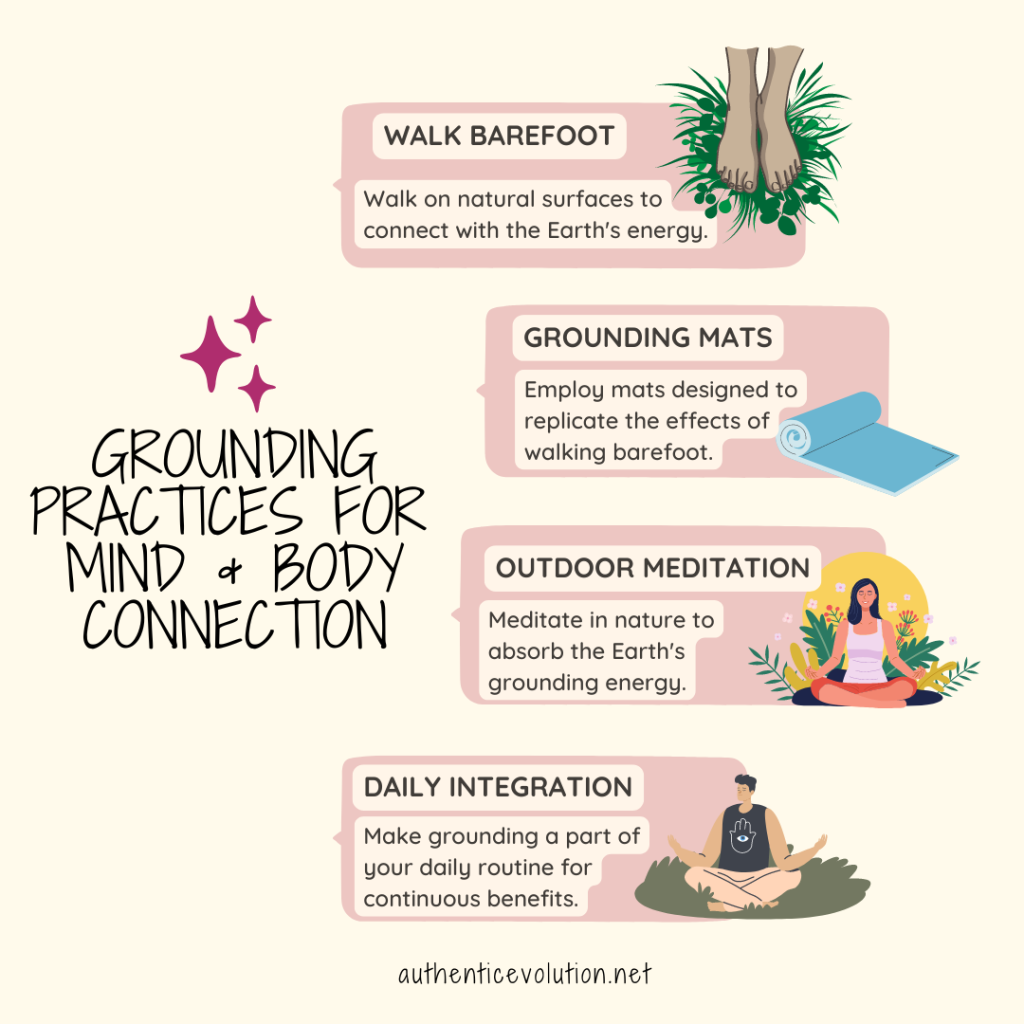
1. Barefoot Walking
Walking barefoot on natural surfaces like grass, sand, or soil is one of the simplest and most effective ways to ground yourself. Aim to walk barefoot for at least 30 minutes a day. Pay attention to the sensations of your feet connecting with the Earth, the texture of the surface, and the temperature of the ground. This mindful approach can enhance the grounding experience and help reduce stress.
If you’re new to barefoot walking, start slowly to allow your feet to adjust. Be mindful of your surroundings and avoid sharp objects or uneven terrain. If walking on rough surfaces, consider using minimalist footwear that allows your feet to maintain contact with the ground.
2. Using Grounding Mats and Sheets
For those who spend most of their day indoors, grounding mats and sheets offer a convenient way to stay connected to the Earth. These products are designed to mimic the effects of direct contact with the ground by using conductive materials that are connected to the Earth via a grounded outlet or a grounding rod.
Place a grounding mat under your feet while sitting at your desk or on the couch, or use a grounding sheet while sleeping. Aim to use these products for at least 30 minutes per session to experience the benefits of grounding.
3. Outdoor Meditation or Yoga
Practicing meditation or yoga outdoors, directly on the ground, is another effective way to ground yourself. Find a quiet spot in nature, such as a park or forest, and sit or stand directly on the grass or soil. Begin your practice by focusing on your breath and the sensation of your body connecting with the Earth. As you move through your session, visualize the Earth’s energy flowing up through your feet and into your body, promoting a sense of calm and balance.
Choose a location that feels safe and peaceful, away from distractions and noise. Use a natural mat, such as a grass mat or a cotton yoga mat, to maintain a connection with the ground. Practicing during the early morning or late afternoon, when the Earth’s energy is most intense, can enhance the grounding experience.
4. Grounding at Work
Even during a busy workday, you can incorporate grounding practices to stay connected with the Earth. Consider using a grounding mat at your desk or taking short breaks to walk barefoot outside. If your workplace has an outdoor area, use it for walking meetings or take your lunch break outside to connect with nature.
5. Grounding at Home
Your home should be a sanctuary where you can relax, recharge, and connect with the Earth. Create a dedicated grounding space in your home, preferably outdoors, where you can regularly practice grounding. This could be a small garden, a balcony, or a corner of your backyard with direct access to natural surfaces like grass or soil.
Enhance this space with comfortable seating, such as a bench or meditation cushions, and add natural elements like plants or a small water feature to create a calming atmosphere. You can also use grounding sheets on your bed to maintain a connection with the Earth throughout the night.
“The Earth has its own energy, and when we connect to it, we align our bodies with its natural rhythms, promoting healing and balance.”— Clinton Ober
The Importance of Grounding in Modern Life
In today’s fast-paced, technology-driven world, grounding provides a simple, accessible, and cost-effective way to support your body’s natural healing processes. Whether you choose to walk barefoot on the Earth, use grounding products, or practice outdoor meditation, making grounding a regular part of your life can have a profound impact on your health.
Make Grounding a Part of Your Daily Routine
Grounding offers a simple yet powerful way to improve your health and well-being. By connecting with the Earth’s natural electrical charge, you can reduce inflammation, improve sleep quality, and boost your mood.
Start small by incorporating a few minutes of grounding into your daily routine. Whether it’s taking a barefoot walk in your backyard or using a grounding mat at work, these small steps can lead to significant improvements in your overall well-being. Embrace the power of nature and make grounding a regular practice in your life.
Further Exploration
If you’re interested in learning more about grounding and its benefits, consider checking out these resources:
“Earthing: The Most Important Health Discovery Ever?” by Clinton Ober, Stephen T. Sinatra, and Martin Zucker
“The Earthing Movie: The Remarkable Science of Grounding” (documentary)
“The Grounded Body: The New Science of Earthing and Its Vital Role in Health and Healing” by Laura Koniver, MD
These resources offer a deeper dive into the science behind grounding and provide practical tips for incorporating it into your life.
You might find this process therapeutic as you tap into and express your repressed shadow self.
So, whether you’re scribbling in a journal or dancing out your feelings, shadow work is all about exploring those hidden parts of yourself and bringing them into the light.
Comments Off on 10 Surprising Benefits of “Woo-Woo” Spiritual Practices for Your Mind and Body
by dpafa
In a world that often dismisses unconventional approaches, embracing the power of spiritual practices can be a game-changer for your mental and physical well-being. Far from being mere superstition, practices like meditation, yoga, and energy healing have been shown to promote relaxation, reduce stress, and cultivate inner peace.
By opening yourself to these alternative paths, you may discover the key to a more balanced, fulfilled, and vibrant life. Ready to dive into how spiritual practices can benefit your mind and body? Keep reading to explore a whole new way of being.
Unlocking Mind-Body Harmony with Spiritual Practices
Spiritual practices offer tangible benefits for both mental and physical well-being. Incorporating these practices into your daily life can lead to reduced stress and improved emotional balance. Scientific research supports the effectiveness of many spiritual techniques, making them valuable tools for overall health.
Stress Reduction and Relaxation
In today’s fast-paced world, stress is an all-too-common experience. Spiritual practices like meditation, yoga, and energy healing provide a powerful antidote to chronic stress, promoting deep relaxation and inner calm. Regular meditation, for example, has been shown to lower cortisol levels, the primary stress hormone. A study published in Health Psychology found that mindfulness meditation significantly decreased cortisol levels over eight weeks, fostering resilience in the face of life’s challenges.
Dr. Herbert Benson, a pioneer in mind-body medicine, coined the term “relaxation response” to describe the physiological changes that occur during deep relaxation. Practices that elicit this response, such as meditation, can lead to decreased heart rate and blood pressure, reduced muscle tension, and increased feelings of well-being. By incorporating these practices into daily life, you can tap into this natural healing mechanism and experience greater overall well-being.
Enhancing Emotional Well-being
Beyond stress reduction, spiritual practices also focus on emotional processing and release. Techniques like journaling, crystal healing, and sound baths offer safe avenues for exploring and navigating difficult emotions. Journaling, for instance, allows for free expression of thoughts and feelings, leading to emotional clarity and release. A study published in JMIR Mental Health found that positive affect journaling significantly increased mental well-being and resilience over three months.
Engaging in practices that promote emotional processing can also enhance emotional intelligence and self-awareness. Mindfulness meditation and expressive arts therapy, for example, help individuals develop a deeper understanding of their emotions, leading to improved relationships and overall life satisfaction. A meta-analysis in Frontiers in Psychology found that mindfulness-based interventions positively affected emotional intelligence across multiple studies.
Understanding the Term “Spiritual Practices”
Spiritual practices encompass a wide range of techniques and beliefs that focus on the connection between mind, body, and spirit. These practices, while sometimes seen as unconventional, have gained popularity for their ability to promote holistic well-being. Examples include meditation, energy healing, crystal therapy, astrology, and certain forms of alternative medicine. A study in the Journal of Alternative and Complementary Medicine found that 38% of Americans use complementary and alternative medicine, including some spiritual practices.
Embracing Spiritual Practices for Mental Health
Embracing spiritual practices signifies an openness to exploring alternative paths to well-being. For many, these practices complement traditional mental health treatments like therapy or medication, offering additional tools for managing stress and fostering inner peace. The National Center for Complementary and Integrative Health found that mindfulness meditation, a spiritual practice, can reduce symptoms of anxiety and depression.
Overcoming Stigma and Skepticism
Despite the benefits, spiritual practices often face stigma and skepticism from those who view them as unscientific or ineffective. However, it’s essential to approach these practices with an open mind, recognizing that what works for one person may not work for another. It’s also important to note that while spiritual practices can be beneficial, they should complement, not replace, professional mental health treatment when needed. The National Alliance on Mental Illness emphasizes the importance of a comprehensive treatment plan that may include alternative approaches.
The Power of Mindfulness and Presence
The Benefits of Mindfulness Meditation
Mindfulness meditation, which involves focusing on the present moment without judgment, has numerous benefits for mental health. A study in Frontiers in Human Neuroscience found that mindfulness meditation can lead to changes in brain structure, particularly in areas associated with attention, emotional regulation, and self-awareness. Participants in an eight-week mindfulness-based stress reduction program showed increased grey matter density in brain regions involved in learning, memory, and self-awareness.
Developing a Consistent Mindfulness Practice
To fully benefit from mindfulness, it’s important to develop a consistent practice. Start with short sessions, gradually increasing the duration over time. Practical tips for establishing mindfulness include:
Finding a quiet, comfortable space
Focusing on your breath
Gently bringing attention back to the breath when the mind wanders
Books like Wherever You Go, There You Are by Jon Kabat-Zinn and The Power of Now by Eckhart Tolle offer guidance for incorporating mindfulness into daily life.
Mindfulness for Mental Health
Mindfulness is a powerful tool for managing mental health challenges like anxiety, depression, and stress. A meta-analysis in the Journal of Consulting and Clinical Psychology reviewed studies on mindfulness-based interventions, finding them effective in reducing symptoms of anxiety and depression. Mindfulness helps train the mind to be less reactive to stressful situations, promoting greater self-awareness and emotional regulation.
“In the vastness of the cosmos, true peace is found not in the stars above, but within the quiet stillness of your own soul.”
— Danielle Aime
Cultivating Self-Compassion and Acceptance
The Power of Self-Love in Spiritual Practices
Many spiritual practices, such as meditation, energy healing, and affirmations, emphasize cultivating self-love and acceptance. By treating ourselves with kindness and compassion, we can improve our overall well-being and attract more positivity into our lives. Self-love involves embracing all aspects of ourselves, including strengths, weaknesses, and imperfections, leading to a stronger foundation for mental and emotional resilience.
Techniques for Building Self-Compassion
Let’s face it: shadow work is not a walk in the park. It involves facing some dark parts of your past and inner psyche. But guess what? Resistance is totally normal. So, be kind to yourself! Here are a few tips to help you navigate this process:
Pay attention to your triggers: As you process memories, you might get hit by feelings of shame. Note the things that trigger you and bring up feelings in your body.
Pay attention to the feelings in your body: Are you tense? Is your heart rate high? These sensations tell you something about your emotions.
Take deep breaths as you process painful memories: Some feelings that surface might be tough. Breathe through it and speak to yourself with compassion.
Take note of thought patterns and habits that repeat themselves: As you journal through the shadow work prompts, you may notice common themes.
Physical Benefits of Spiritual Practices: Holistic Healing for the Body
Gentle Movement and Body Awareness
Spiritual practices like yoga, tai chi, and qigong combine mindful movement with breathwork, benefiting both mind and body. Regular practice improves flexibility, balance, and overall fitness. A study in Evidence-Based Complementary and Alternative Medicine found that a 12-week yoga program significantly improved these physical attributes in healthy adults.
Supporting the Body’s Natural Healing Processes
Spiritual modalities like acupuncture and reiki stimulate the body’s innate healing abilities. Acupuncture has been shown to alleviate chronic pain and improve circulation, while reiki may help reduce stress and pain. A meta-analysis in the Journal of Pain found acupuncture effective in reducing chronic pain and improving quality of life. While reiki requires more rigorous research, it shows promise in reducing pain and anxiety.
Nourishing the Body with Mindful Eating
Mindful eating, rooted in spiritual principles, involves paying attention to the sensory experience of eating and tuning into the body’s hunger and satiety cues. This practice can improve digestion, maintain a balanced weight, and foster a positive relationship with food. A review in Nutrition Research Reviews found mindful eating interventions effective in reducing binge eating and improving self-control and body satisfaction.
Embracing Nature’s Healing Touch
Spiritual philosophies emphasize the importance of connecting with nature for well-being. Practices like forest bathing and earthing harness nature’s healing power to promote health. Forest bathing, or shinrin-yoku, has been associated with decreased cortisol levels and improved immune function. Earthing involves direct contact with the earth’s surface, which may reduce inflammation and improve sleep.
Incorporating Spiritual Practices in Daily Life: Simple Practices for Busy Schedules
Micro-Practices for Mindfulness and Grounding
Incorporating spiritual practices into daily life can be simple, even for busy professionals. Micro-practices, like taking short meditation breaks or conducting mindful check-ins, help maintain calm and balance throughout the day. These small moments of mindfulness and self-care can build resilience and emotional balance over time.
Creating Sacred Space and Ritual
Creating sacred spaces and rituals can make spiritual practices more inviting and accessible. This could be a dedicated area in your home for meditation or a small altar with meaningful objects. Simple rituals, like lighting a candle or setting an intention for the day, can infuse your routine with purpose and magic.
Benefits of Consistent Practice
Engaging in personally meaningful rituals enhances your sense of well-being and fosters a deeper connection to your intuition. By prioritizing mindfulness, sacred space, and rituals, you can infuse your days with greater peace, purpose, and magic.
Incorporating Spiritual Practices in Daily Life: Simple Practices for Busy Schedules
Micro-Practices for Mindfulness and Grounding
Incorporating spiritual practices into daily life can be simple, even for busy professionals. Micro-practices, like taking short meditation breaks or conducting mindful check-ins, help maintain calm and balance throughout the day. These small moments of mindfulness and self-care can build resilience and emotional balance over time.
Creating Sacred Space and Ritual
Creating sacred spaces and rituals can make spiritual practices more inviting and accessible. This could be a dedicated area in your home for meditation or a small altar with meaningful objects. Simple rituals, like lighting a candle or setting an intention for the day, can infuse your routine with purpose and magic.
Benefits of Consistent Practice
Engaging in personally meaningful rituals enhances your sense of well-being and fosters a deeper connection to your intuition. By prioritizing mindfulness, sacred space, and rituals, you can infuse your days with greater peace, purpose, and magic.
Choosing the Right Spiritual Practices: Experimentation and Intuition
Exploring Different Modalities
With many spiritual practices available, it can be overwhelming to know where to begin. Experimenting with different modalities allows you to discover which ones align with your beliefs and goals. Start by researching and trying out practices that pique your interest, then commit to incorporating them into your life for a set period.
Trusting Your Intuition and Inner Guidance
While external resources are valuable, your intuition is the most powerful tool for navigating your spiritual journey. Learning to trust your inner guidance helps you make decisions aligned with your values and navigate challenges with greater clarity and resilience.
Embracing the Magic Within
Spiritual practices offer a pathway to mind-body harmony, emotional well-being, and holistic healing. From stress reduction to self-compassion, these unconventional approaches can profoundly impact mental and physical health. Whether through mindfulness meditation, energy healing, or creating sacred rituals, the key is to find practices that resonate with your unique needs and intuition. Start today by incorporating a simple micro-practice into your daily routine, and experience the transformative benefits of spiritual practices firsthand.
Comments Off on A Step-by-step Guide to Healing Trauma with Spiritual and Somatic Practices
by dpafa
I used to roll my eyes at the mere mention of energy work. Reiki, chakra healing, acupuncture—it all sounded like a bunch of woo-woo nonsense to me.
But then, something unexpected happened. A single energy work session completely transformed my perspective and set me on a path of profound personal growth. As I continued my journey, I realized that energy work wasn’t just about relaxation or stress relief; it became an essential part of my healing process, especially when dealing with deep-rooted trauma.
Trauma impacts not just the mind but also the body and spirit. Healing from trauma requires a holistic approach that addresses all these aspects. In this post, I’ll share how my skepticism turned into belief, and how you can use spiritual and somatic practices to heal trauma and facilitate deep healing.
How Energy Work Transformed My Personal Growth Journey
Overcoming deep-rooted skepticism
Growing up in a society that values tangible evidence and scientific proof, I was deeply skeptical about energy work. The idea of invisible forces influencing our lives and well-being seemed far-fetched, and I struggled to wrap my mind around it. But my lack of understanding fueled my doubts, making me resistant to considering energy work as a viable option for personal growth—especially for something as serious as trauma.
The pivotal moment of change
Despite my skepticism, a close friend convinced me to attend an energy work session with her. I went along reluctantly, more out of curiosity than belief that it would have any impact on me. But this experience marked a turning point in my personal growth journey.
During the session, I was surprised by the immediate sensations in my body. A deep sense of relaxation washed over me, and I became acutely aware of subtle energetic shifts. The practitioner guided me through exercises designed to balance and align my energy centers, and I couldn’t deny the profound effects I was experiencing.
In the days following the session, I noticed significant changes in my overall well-being. I felt lighter, more centered, and better equipped to handle daily challenges. The experience opened my eyes to the transformative power of energy work, particularly in healing deep-seated trauma.
Step 1: Grounding and Safety
Before diving into deeper healing, it’s crucial to establish a sense of safety and grounding. Trauma can leave you feeling disconnected from your body and the present moment, so grounding techniques are the foundation for effective healing. I found that these practices were essential as I began my journey with energy work.
Earthing:
Walking barefoot on natural surfaces like grass or sand to connect with the earth’s energy became a simple yet powerful practice for me. It helped me feel more present and anchored in my body, which was vital in the early stages of my healing.
Tree Visualization:
Another technique I embraced was visualizing myself as a tree with deep roots extending into the earth. This practice allowed me to release tension and stress, creating a stable foundation for the deeper work ahead.
Anchoring in the Present MomentSometimes, trauma can pull us out of the present moment, making it difficult to feel safe. To counteract this, I practiced anchoring techniques such as focusing on my breath, naming objects around me, or feeling the texture of an object in my hands. These practices helped me stay grounded and present, which is crucial for effective healing.
Step 2: Awareness and Mindfulness
As I continued exploring energy work, I realized the importance of cultivating awareness of how trauma manifests in the body and mind. Mindfulness practices became a key component of my healing, helping me observe thoughts, emotions, and physical sensations without judgment.
Body Scanning
I began practicing body scanning, mentally scanning my body from head to toe, noticing areas of tension or discomfort. This practice helped me connect more deeply with my body and identify where trauma was stored.
Mindful Observation
I also incorporated mindful observation into my daily life, observing my thoughts and emotions as they arose. This helped me identify patterns and triggers related to my trauma, setting the stage for deeper healing.
Reflective Journaling
Journaling about my mindfulness practice allowed me to track my progress and understand how my thoughts and emotions were evolving. By reflecting on my daily experiences, I could see patterns emerging and make more informed decisions about my healing journey.
Step 3: Somatic Release Techniques
Trauma is often stored in the body, and somatic practices helped me release this trapped energy. These techniques, which work directly with the body, became essential tools in my healing journey.
Shaking
I discovered the power of shaking—a simple yet effective way to release tension and stress stored in the body. Starting with gentle movements and gradually engaging the whole body, I found relief and relaxation.
Tension & Trauma Releasing Exercises (TRE)
These exercises, which involve specific movements to activate the body’s natural tremoring mechanism, became a regular part of my routine. They helped me release deep muscular patterns of stress and trauma.
Breathwork
Incorporating breathwork into my practice allowed me to connect with my body on a deeper level. Techniques like deep diaphragmatic breathing, alternate nostril breathing, and breath of fire helped me release tension and anxiety, creating space for healing.
Somatic Experiencing
This technique, developed by Dr. Peter Levine, focuses on releasing trauma from the body by gently guiding individuals to re-experience traumatic events in a safe and controlled way. Somatic experiencing helped me process my trauma without feeling overwhelmed, allowing my body to release stored energy and tension.
Step 4: Spiritual Healing and Energy Work
As my journey continued, I turned to spiritual practices to address the energetic imprints of trauma and restore balance. These practices offered a way to connect with something greater than myself, providing comfort and support during the healing process.
Reiki
I began receiving Reiki sessions regularly, which involved the transfer of universal life force energy through a practitioner’s hands. These sessions helped balance my energy, promoting relaxation and releasing emotional blockages.
Chakra Healing
I also explored chakra healing, focusing on balancing the seven main chakras in my body. Using visualization, crystals, and sound healing, I worked on clearing and aligning each chakra, which greatly supported my emotional and spiritual well-being.
Sound Healing
Sound healing uses vibrational sound to help reduce stress and promote healing. I incorporated tools like singing bowls, tuning forks, and gongs into my practice to facilitate deep relaxation and release of emotional and physical blockages.
Meditation and Visualization
Meditation and visualization became daily practices that helped me connect with my inner self and the spiritual realm. Guided meditations focused on healing, forgiveness, and self-compassion were particularly helpful in releasing trauma and cultivating a sense of peace.
Step 5: Integrating the Healing Process
Healing isn’t just about releasing trauma; it’s also about integrating the insights and changes into daily life. This step was crucial for maintaining the progress I’d made and continuing my journey toward wholeness.
Journaling
I started journaling my experiences, insights, and emotions. This practice helped me process what I’d learned and integrate it into my daily life, reinforcing the positive shifts I was experiencing.
Daily Rituals
Incorporating small, consistent practices into my daily routine, such as morning meditation or grounding exercises, helped maintain the positive changes. These rituals became an integral part of my self-care, supporting my continued growth and healing.
Building a Support Network
Healing can be a lonely journey, but it doesn’t have to be. I found it invaluable to build a support network of like-minded individuals who understood my path. Whether through support groups, online communities, or spiritual gatherings, connecting with others helped me stay motivated and feel supported.
Continuous Learning and Growth
Healing is an ongoing process. I committed to continuous learning by reading books, attending workshops, and working with various healers and therapists. This not only deepened my understanding but also kept me engaged and open to new experiences.
Giving Back
As I healed, I felt called to help others on their healing journeys. Whether through volunteering, mentoring, or simply sharing my story, giving back became a powerful way to integrate my healing and stay connected to my purpose.
“Healing is a journey that begins with the courage to explore the unseen and ends with the profound transformation of body, mind, and spirit.”
— Danielle Aime
Embracing Your Healing Journey
Energy work, once shrouded in skepticism, has the potential to profoundly impact your personal growth journey, especially when it comes to healing trauma. By combining spiritual and somatic practices, you can tap into the subtle energies that flow within and around you, facilitating self-discovery, emotional healing, and a deeper connection to your intuition.
As you explore these practices, remember to ground yourself, cultivate awareness, and integrate the healing process into your daily life. The ripple effect of energy work extends far beyond personal growth, positively influencing your relationships, communication, and alignment with your authentic self-expression and life purpose.
Are you ready to explore the transformative power of energy work and unlock new dimensions of personal growth and well-being?
But then, something unexpected happened. A single energy work session completely transformed my perspective and set me on a path of profound personal growth. As I continued my journey, I realized that energy work wasn’t just about relaxation or stress relief; it became an essential part of my healing process, especially when dealing with deep-rooted trauma.
Trauma impacts not just the mind but also the body and spirit. Healing from trauma requires a holistic approach that addresses all these aspects. In this post, I’ll share how my skepticism turned into belief, and how you can use spiritual and somatic practices to heal trauma and facilitate deep healing.
Comments Off on Discovering Your Shadow Self: Proven Techniques for Personal Growth
by dpafa
Unmasking the Shadow Self: 15 Transformative Techniques for Inner Exploration
Do you ever feel disconnected from your true self, grappling with hidden fears, desires, or impulses that contradict your conscious identity? Welcome to the realm of the shadow self—the repressed aspects of your psyche that hold the key to profound personal growth and self-acceptance.
In this guide, we’ll explore 15 transformative techniques to confront, heal, and integrate the darkest parts of ourselves. From uncovering childhood wounds to embracing creative self-expression, these practices will challenge you to face your shadows head-on and unlock your untapped potential.
Ready to peel back the layers of your psyche and discover the authentic self that lies beneath? Let’s dive in.
Confront Your Shadow Self with These Powerful Inner Work Techniques
Begin by uncovering hidden aspects of your personality through self-reflection and journaling. Identify emotional triggers and patterns to gain deeper self-awareness. Consider working with a therapist or coach specializing in Jungian psychology for expert guidance.
Identify Your Emotional Triggers
A crucial step in confronting your shadow self is becoming aware of your emotional triggers—people, situations, or events that provoke intense emotional reactions, such as anger, jealousy, shame, or fear. By observing your reactivity patterns, you can recognize the aspects of yourself that you tend to suppress or hide.
Journaling Prompts for Uncovering Emotional Triggers:
What situations or people tend to provoke strong emotional reactions in me?
When I feel triggered, what thoughts and beliefs arise?
What aspects of myself do I tend to suppress or hide when I’m triggered?
Practice Self-Reflection Exercises
Engaging in regular self-reflection helps you confront your shadow self. Set aside time for introspection and self-inquiry. Ask yourself tough questions about your beliefs, values, and behaviors. Explore parts of yourself that you may have disowned or rejected.
Guided Meditations for Shadow Work
Use guided meditations or visualizations focusing on shadow work or inner child healing. These meditations often involve dialoguing with different aspects of yourself, such as your inner critic or wounded inner child. This safe, imaginative space allows valuable insights and starts the process of integration.
Work with a Therapist or Coach Specializing in Jungian Psychology
While self-guided shadow work is possible, working with a trained professional provides invaluable support and guidance. A therapist or coach specializing in Jungian psychology can help you uncover and integrate your shadow aspects, using techniques like dream analysis, active imagination, or role-playing.
Heal Your Inner Child to Transform Your Shadow Self
Identify Your Childhood Wounds and Unmet Needs
Reflect on your early experiences to heal your inner child and transform your shadow self. Explore how childhood shaped your beliefs, behaviors, and patterns, and consider any unmet emotional needs. Recognizing these unresolved wounds is essential for shadow work, allowing you to integrate them healthily.
Practice Reparenting and Self-Compassion
Once you’ve identified your childhood wounds, offer yourself the love and support you needed as a child. Reparenting involves treating yourself with kindness, understanding, and validation. Engage in nurturing activities like self-care, play, and creative expression to reconnect with your inner child.
Develop self-compassion by speaking to yourself as you would a dear friend. When feelings of shame, guilt, or self-criticism arise, meet them with gentleness and understanding. Remember that your inner child is not to blame for past hurts or current struggles.
Use Inner Child Healing Visualizations and Meditations
Visualization and meditation are powerful tools for inner child work. Find a quiet space, relax, and turn your attention inward. Imagine yourself as a child, at an age when you felt particularly vulnerable. Engage in a dialogue with your inner child, offering reassurance and creating a safe, nurturing space.
“To confront the shadow is to confront the truth of who we are—both the light and the dark—so that we may live as our most authentic selves.”
— Danielle Aime
Embrace Your Shadow Through Creative Self-Expression
Creative self-expression provides a powerful avenue for exploring and integrating your shadow self. Through art therapy, journaling, and role-playing techniques, you can tap into hidden aspects of your psyche and bring them into the light of awareness.
Use Art Therapy Techniques to Explore Your Shadow
Art therapy offers a non-verbal way to express and process emotions, fears, and desires that may lurk in your shadow. Create visual representations of your inner world to gain new insights and perspectives on the parts of yourself you may have been avoiding or denying.
Art Therapy Techniques:
Draw, paint, or sculpt images representing your shadow aspects. Allow yourself to create freely, without judgment or self-censorship.
Create a collage of images that evoke your hidden desires, fears, and impulses. Reflect on any themes or patterns that emerge.
Write poetry or stories that give voice to your shadow self, allowing it to express itself fully.
Shadow Work Journaling Prompts:
What qualities or traits do I most judge or criticize in others? How might these reflect my shadow self?
What desires or impulses am I most ashamed or afraid of? How can I explore these safely and healthily?
What parts of myself have I been neglecting or denying? How can I give them a voice and incorporate them into my life?
Use Role-Playing or Drama Therapy to Embody Your Shadow
Role-playing and drama therapy allow you to physically embody and explore your shadow aspects in a safe environment. By taking on the role of your shadow self, you can gain a deeper understanding of its underlying emotions, motivations, and needs.
Drama Therapy Techniques:
Take on the role of your shadow in a private, supportive space. Notice how it feels to embody this aspect of yourself.
Engage in dialogues or improvisations with your shadow character, allowing each part to express its perspective.
Explore the emotions, motivations, and needs underlying your shadow behaviors.
Harness the Power of Your Shadow for Personal Growth
Acknowledge and Accept Your Shadow Aspects Without Judgment
Recognize that your shadow is a natural part of your psyche, made up of traits, desires, or emotions you may have repressed or denied. Approach your shadow with curiosity and openness rather than fear or resistance.
Find Healthy Outlets for Expressing Your Shadow Energies
Once you’ve acknowledged your shadow aspects, find healthy ways to express and integrate these energies into your life. Channel your shadow into constructive activities like exercise, art, or activism. Practice setting boundaries and assertiveness to express your needs and desires.
Cultivate a Growth Mindset Around Your Shadow Work
View your shadow as an opportunity for learning and transformation. Embrace the lessons it offers and celebrate the progress and insights gained through inner work.
“Embracing the shadow within us is not about dwelling in darkness, but about illuminating the hidden corners of our psyche to reveal the full spectrum of our humanity.”
— Danielle Aime
Common Misconceptions About Shadow Work
Shadow Work Is Not About Indulging in Negativity: The true purpose of shadow work is to acknowledge and integrate hidden aspects of ourselves, not to dwell on them excessively.
Perfection Is Not the Goal of Shadow Work: The goal is not to eliminate shadow aspects but to integrate them healthily and balanced.
Shadow Work Requires Deep Introspection: Genuine shadow work involves deep introspection and a willingness to confront uncomfortable truths about ourselves.
The Key to Integrating Your Shadow
Ultimately, shadow work and integrating your shadow come down to one primary thing: acceptance. Can you accept the reality of the insights that arise through inner work? Acceptance leads to greater psychological maturity and a more fluid life.
By helping dismantle the false self, shadow work paves the way to bring you closer to your true self.
Embracing Your Wholeness Through Shadow Work
Shadow work is an ongoing journey of self-acceptance and integration. Be patient and compassionate with yourself as you explore the depths of your psyche.
What one small step can you take today to start embracing your shadow? Whether it’s self-reflection, reaching out to a therapist, or expressing your feelings through art, trust that engaging in this transformative work cultivates greater wholeness, resilience, and authenticity in all areas of your life.
Are negative thoughts and limiting beliefs keeping you stuck?
Imagine if you could rewire your brain for positive change and manifest the life you’ve always desired.
Affirmations offer a powerful way to reshape your mindset, bringing your dreams into reality. By tapping into the brain’s natural ability to change, known as neuroplasticity, you can create lasting shifts in your thoughts, beliefs, and, ultimately, your reality.
In this article, we’ll explore the science of affirmations, guide you on how to craft impactful statements, and introduce you to 7 transformative affirmations to help you manifest a more positive and fulfilling life.
Rewiring Your Brain with Affirmations: How to Create Positive Change and Manifestation
Understanding the Power of Neuroplasticity
Neuroplasticity is the brain’s incredible ability to form new connections and adapt to new experiences. This means that your thoughts and beliefs can literally reshape your brain over time. By consistently reinforcing positive thoughts through affirmations, you can rewire your brain to support not just positive change but also the manifestation of your deepest desires.
Research supports that the brain can form new neural pathways well into adulthood. For example, a study published in *Nature Communications* found significant brain changes in adults who practiced a new skill for just two weeks, highlighting the profound impact of neuroplasticity. When you align your affirmations with your manifestation goals, you are actively guiding your brain to create the reality you envision.
The Role of Consistent Practice in Manifestation
Rewiring your brain with affirmations requires consistent practice. Just like learning a new skill, repetition is key to creating lasting change. By regularly repeating affirmations, especially those focused on manifestation, you strengthen the neural pathways associated with positive thoughts, making them more automatic and ingrained in your mindset.
Experts like Charles Duhigg in *The Power of Habit* and James Clear in *Atomic Habits* emphasize the importance of consistency in building habits. Similarly, Norman Doidge in *The Brain That Changes Itself* illustrates the brain’s capacity to reorganize itself through new experiences and learning. Consistently focusing your affirmations on what you want to manifest helps create a strong mental foundation for attracting those outcomes into your life.
Incorporating Affirmations into Your Daily Manifestation Routine
To fully benefit from affirmations and to aid in manifestation, it’s crucial to make them a consistent part of your daily life. Choose a quiet time and space where you can focus on your affirmations without distractions. Many find practicing affirmations first thing in the morning or just before bed most effective, as these times are when your mind is most receptive to new ideas.
Pairing Affirmations with Visualization for Manifestation
Enhance the power of your affirmations by pairing them with visualization, a key component in manifestation practices. As you repeat each affirmation, visualize yourself embodying the qualities or achieving the goals you’re affirming. Engage all your senses in this process, making the visualization as vivid and realistic as possible. This not only deepens your emotional connection to the affirmation but also accelerates the manifestation process, as your brain begins to see these outcomes as achievable realities.
Optimal Frequency and Duration for Manifesting Your Desires
For best results, repeat your affirmations multiple times a day. Aim for 10-15 repetitions per session, focusing on the feeling and belief behind each word. Consistency matters more than length, so even a few minutes a day can lead to significant positive change and powerful manifestations over time.
Here’s a sample daily affirmations routine focused on manifestation:
| Time of Day | Affirmation Practice | | Morning | 10-15 repetitions of each affirmation, paired with visualization | | Midday | 5-10 repetitions of each affirmation, focusing on feeling and belief | | Evening | 10-15 repetitions of each affirmation, reflecting on progress and gratitude |
By harnessing the power of neuroplasticity and making affirmations a daily practice, you can rewire your brain for positive change and begin to manifest the life you desire. As you continue to practice, you’ll notice shifts in your thoughts, emotions, and behaviors, aligning more closely with the reality you wish to create.
The power to create your reality lies in the belief that it’s already yours.
— Danielle Aime
The Science Behind Affirmations: How They Work for Positive Change and Manifestation
The Role of Self-Talk in Shaping Beliefs and Manifestation
Your inner dialogue plays a crucial role in shaping your beliefs, perceptions, and ultimately, what you manifest in your life. Negative self-talk reinforces limiting beliefs, while positive self-talk through affirmations can counteract these patterns and pave the way for manifestation. By consciously choosing to repeat positive statements, you start to reframe your perspective and boost self-confidence, making it easier to manifest your goals.
The Power of Neuroplasticity in Manifestation
Neuroplasticity supports the effectiveness of affirmations, especially when used with the intent of manifestation. By consistently engaging in positive self-talk, you create new neural pathways that grow stronger over time, similar to how muscles build with exercise. The more you practice affirmations focused on manifestation, the more automatic and powerful these positive thought patterns become, making it easier for you to attract your desires into reality.
The Psychological and Physiological Effects of Affirmations
Affirmations not only uplift your mental state but also have measurable effects on your body, which are crucial for successful manifestation. Positive self-talk activates the brain’s reward centers, releasing feel-good hormones like dopamine and serotonin. This can reduce stress, improve sleep, and enhance overall well-being—creating the perfect internal environment for manifesting your dreams.
The Science of Self-Affirmation Theory and Manifestation
Self-affirmation theory, developed by Claude Steele, suggests that affirmations help maintain self-integrity, making it easier to handle stress and challenges. Research has shown that self-affirmation can improve problem-solving abilities and increase receptivity to positive information, making it a powerful tool for personal growth and manifestation.
Crafting Effective Affirmations for Success and Manifestation
Key Elements of a Powerful Affirmation for Manifestation
Effective affirmations go beyond mere positive thinking. To fully harness their potential for manifestation, affirmations should be present-tense, specific, and emotionally charged.
Use Present Tense and Positive Language for Manifestation
Affirmations should be stated as if your desired outcome is already a reality, which helps your subconscious mind accept it as truth. This is particularly important in manifestation, where belief in your ability to achieve your desires is key. Focus on positive statements to direct your mind toward what you want to manifest, rather than what you don’t.
Make Affirmations Specific and Emotionally Charged for Manifestation
Vague affirmations lack the power to create lasting change or to manifest specific outcomes. Make them specific to your goals, and infuse them with emotion. The more emotionally charged your affirmations are, the more deeply they’ll resonate with your subconscious and support your manifestation efforts.
Ensure Affirmations Align with Your Core Values and Manifestation Goals
For affirmations to be effective in manifestation, they must align with your core values. When affirmations conflict with deeply held beliefs, they can create internal resistance. Reflect on what truly matters to you and craft affirmations that support your authentic self and your manifestation goals.
Personalizing Affirmations for Maximum Impact in Manifestation
Tailor your affirmations to your specific needs to amplify their effectiveness, particularly in manifestation. Craft affirmations that resonate with your unique situation, and adjust them as your goals and circumstances evolve.
Incorporating Affirmations into Your Daily Manifestation Routine
To make affirmations a powerful tool for positive change and manifestation, integrate them into your daily routine. Set aside time each day, write them down, say them aloud, and combine them with visualization for a more impactful experience.
Embrace the Power Within: Affirmations for a Transformed and Manifested Life
Affirmations are more than just positive statements—they’re a pathway to rewiring your brain for positive change and manifesting your dreams. By consistently practicing affirmations with intention, you can reshape your thoughts, beliefs, and reality.
Make affirmations a non-negotiable part of your self-care routine. Combine them with meditation, mindfulness, and journaling to deepen their impact and enhance your manifestation efforts. Start today by choosing an affirmation that resonates with you and commit to repeating it daily for the next 30 days. Notice how your mindset, emotions, and experiences shift as you consistently affirm and manifest your desired reality.
The power to create positive change and manifest your dreams lies within you. Embrace your inner strength, trust the process, and watch as your life unfolds in beautiful and unexpected ways.
Intuition goes beyond just a gut feeling – it’s a transformative tool for personal growth. Over my 15 years of coaching, I’ve seen how nurturing intuition leads to breakthroughs in self-awareness, decision-making, and overall life satisfaction.
In this article, we’ll explore:
The key benefits of honing your intuition
Proven strategies to strengthen your intuitive skills
Real-life stories of intuition-led transformations
The fascinating science behind intuitive insights
Practical tips for cultivating an intuitive lifestyle
Whether you’re experienced or just beginning to tap into your inner wisdom, this guide will provide the knowledge and tools to harness the power of intuition for lasting personal evolution.
Ready to trust your gut and unlock your full potential? Let’s dive in.
Understanding Intuition in Personal Growth
Intuition is often described as an inner knowing or gut feeling that guides our decision-making process. It’s a powerful tool that can help us navigate the complexities of personal growth and self-improvement. When we tap into our intuition, we access a deeper level of wisdom that goes beyond rational thinking.
In personal development, intuition acts as an internal compass, helping us align our choices with our values and goals. By listening to our intuitive promptings, we can make decisions that feel authentic and true to ourselves. This inner guidance system complements our logical reasoning, providing a holistic approach to self-improvement.
The Role of Self-Awareness in Developing Intuition
Cultivating self-awareness is crucial for strengthening our intuitive abilities. As we become more attuned to our thoughts, emotions, and bodily sensations, we can better discern the subtle messages our intuition sends us. Regular practices like mindfulness meditation, journaling, and self-reflection can help us develop a keener sense of self-awareness and, in turn, enhance our intuitive skills.
Key Benefits of Honing Intuition for Self-Improvement
When we learn to trust and follow our intuition, we experience numerous benefits in our personal growth journey:
Enhanced self-trust and confidence: By consistently making choices that align with our intuitive guidance, we build greater trust in ourselves and our abilities. This increased self-confidence allows us to tackle challenges with more ease and grace.
Aligned decision-making: Intuition helps us make decisions that support our values, passions, and long-term goals. When we listen to our inner wisdom, we’re more likely to choose paths that lead to fulfillment and satisfaction.
Improved problem-solving skills: Intuitive insights often arise when we’re faced with complex problems or uncertainties. By tapping into our intuition, we can access creative solutions and novel perspectives that our rational mind might overlook.
Navigating Life’s Challenges with Intuitive Wisdom
Life inevitably presents us with obstacles and difficult decisions. In these moments, our intuition can be a powerful ally, helping us navigate the unknown with greater clarity and confidence. By trusting our gut instincts, we can more easily identify the best course of action, even in the face of uncertainty.
However, it’s important to balance intuitive promptings with rational analysis and factual information. By integrating both intuitive and logical approaches, we can make well-rounded decisions that support our overall well-being and growth.
Strategies for Developing and Trusting Intuition
Practice mindfulness and self-reflection: Regularly engage in activities that promote self-awareness, such as meditation, journaling, or contemplative practices. By turning inward and observing our thoughts and feelings without judgment, we create space for intuitive insights to emerge.
Pay attention to bodily sensations: Our intuition often communicates through physical cues, such as gut feelings, goosebumps, or a sense of unease. Learn to recognize and interpret these bodily signals as potential intuitive messages.
Cultivate a growth mindset: Embrace challenges and view mistakes as opportunities for learning and growth. A growth mindset allows us to take risks and trust our intuition, even when the outcome is uncertain.
Seek out diverse experiences and perspectives: Expose yourself to new ideas, cultures, and viewpoints. Engaging with diverse perspectives can help expand your intuitive capacity and provide fresh insights into your personal growth journey.
“Trusting your intuition is like unlocking a secret map to your true self, guiding you through the complexities of life with clarity and confidence. Embrace your inner wisdom and watch as your life transforms.”
— Danielle Aime
Real-Life Examples of Intuition-Led Breakthroughs
Throughout my 15 years as a personal development coach, I’ve witnessed countless instances where clients have experienced significant breakthroughs by trusting their intuition. One memorable case involved a client who had been stuck in an unfulfilling career for years. Despite their initial hesitation, they decided to follow their gut instinct and pursue a passion for teaching. This decision led them to a rewarding career change that not only provided a sense of purpose but also improved their overall well-being.
Another striking example is that of an individual who had been struggling with a pattern of unsatisfying relationships. By learning to trust their intuition, they were able to identify and break free from a cycle of unhealthy partnerships. This client’s newfound trust in their instincts ultimately guided them towards a transformative, loving relationship that supported their personal growth.
In the realm of education, I recall a student who was torn between two seemingly promising academic paths. After deep introspection and learning to listen to their inner voice, they chose a field of study that truly resonated with their values and interests. This intuition-led decision set them on an enriching educational journey that unlocked their full potential and led to a successful career.
One of the most significant obstacles I’ve observed in coaching clients is the fear of making the wrong decision. Many individuals struggle with self-doubt and second-guessing their intuitive promptings. To overcome this, I encourage clients to practice self-compassion and learn to trust themselves. By acknowledging that mistakes are a natural part of the growth process, they can gradually build confidence in their intuitive abilities.
Another common hurdle is the influence of external expectations and societal pressures. Clients often find it challenging to differentiate between their own intuitive guidance and the opinions of others. To address this, I guide them through exercises that help them reconnect with their authentic selves and develop a stronger sense of inner knowing. This may involve techniques such as mindfulness, journaling, or visualization practices.
How Developing Intuition Accelerates Personal Development
As clients strengthen their intuitive abilities, they often experience a ripple effect that extends to various aspects of their lives. Trusting their instincts leads to greater self-awareness, enabling them to identify and address limiting beliefs and patterns that may have been holding them back.
Moreover, intuitive decision-making empowers individuals to take ownership of their lives and actively shape their destinies. By aligning their choices with their deepest values and aspirations, they experience a greater sense of fulfillment and purpose. This, in turn, fuels their motivation and resilience in the face of challenges.
Developing intuition also enhances problem-solving skills and adaptability. When faced with complex situations, intuitive individuals can tap into their inner wisdom to navigate uncertainty and find creative solutions. This agility is particularly valuable in today’s rapidly changing world, where the ability to trust one’s instincts can be a significant advantage.
Practical Exercises to Strengthen Intuition
Setting Intuitive Intentions and Tracking Their Manifestation: Each morning, set an intention to connect with your intuition throughout the day. This could be as simple as “I am open to receiving intuitive guidance today.” Keep a journal nearby to record any intuitive insights or hunches that arise. At the end of the day, reflect on how your intuition manifested and any actions you took as a result.
Practicing Embodied Intuition Through Movement and Somatic Awareness: Intuition often communicates through physical sensations and emotions. By tuning into your body’s wisdom, you can access deeper intuitive insights. Engage in practices like yoga, dance, or mindful walking, focusing on the sensations and emotions that arise. Notice any areas of tension or relaxation, and allow your body to guide you towards intuitive truths.
Exploring Intuitive Tools Like Oracle Cards, Dream Work, and Synchronicity: Intuitive tools can provide additional guidance and support on your journey. Oracle cards offer intuitive messages and symbolism, while dream work allows you to tap into your subconscious wisdom. Pay attention to synchronicities – meaningful coincidences that offer intuitive guidance. Keep a dream journal and record any significant symbols or messages that emerge.
Balancing Intuition with Critical Thinking
While intuition is a valuable tool for personal growth, it’s essential to balance gut instincts with critical thinking. Using intuition as a starting point for exploration allows individuals to identify potential paths forward, but it’s crucial to gather data and facts to validate or refine these initial hunches. By iterating between intuitive insights and analytical reasoning, individuals can make well-informed decisions that align with their goals and values. This process involves gathering relevant information, considering multiple perspectives, and weighing the pros and cons of different options.
Nurturing Intuitive Relationships and Communities
Surrounding yourself with individuals who value and nurture intuitive wisdom is crucial for cultivating an intuitive lifestyle. Seek out mentors, coaches, or allies who have experience in developing their intuition and can offer guidance and support. Engage in conversations that explore the role of intuition in personal and professional life, and learn from their insights and experiences.
Collaborate with others who share your interest in intuitive development. Participate in workshops, retreats, or online communities where you can connect with like-minded individuals. Engage in intuitive exercises and practices together, such as group meditations, intuitive journaling, or creative activities that foster intuitive expression. By co-creating with others, you expand your intuitive abilities and gain new perspectives.
Embracing Your Inner Compass for Lifelong Growth
Intuition is a powerful tool that can guide us towards personal evolution and fulfillment. By learning to trust our gut instincts, we can make decisions that align with our true values and goals. Developing intuitive skills through practices like mindfulness, journaling, and seeking new experiences can enhance our self-awareness and confidence.
Integrating intuition into your daily life can lead to transformative breakthroughs, as demonstrated by real-life examples of individuals who followed their intuitive guidance to pursue meaningful careers, relationships, and educational paths. The science behind intuition reveals that it draws on subconscious pattern recognition and interacts with analytical thinking in the brain.
To cultivate an intuitive lifestyle, start by incorporating practices that allow you to tune into your inner wisdom, such as morning rituals, self-care routines, and downtime for reflection. Surround yourself with supportive mentors and communities that value intuitive insights and foster growth-oriented collaborations.
Take a moment to reflect on your current intuitive capacity. When have you followed your instincts and experienced positive outcomes? In what areas of life could you benefit from trusting your gut more? Consider setting intuitive intentions, exploring embodied practices, and engaging with tools like oracle cards or dream work to deepen your connection to your inner guidance.
What’s one small step you can take today to start honoring your intuition more fully? Maybe it’s pausing to listen to your gut feeling when making a decision or carving out time for a mindful activity that allows your intuitive insights to surface. Trust that your intuition is always leading you towards your highest growth and well-being.
Skepticism and spirituality might seem like the ultimate odd couple, but what if there’s a secret connection waiting to change your life?
Skeptics often brush off spiritual practices as mere superstition or wishful thinking. But what if there’s genuine value hidden beneath all that mystical mumbo jumbo?
In this eye-opening journey, we’ll dive into the unexpected benefits of spirituality for even the most doubtful minds. From boosting mental health to encouraging personal growth, the power of spiritual practices is undeniable.
We’ll also clear up some big misunderstandings about spirituality and share science-based methods that help skeptics reap the benefits without sacrificing their beliefs.
So, if you’re a skeptic curious about spirituality’s potential, come along for the ride. You might just find the fulfillment you’ve been looking for all along.
Skepticism about spiritual practices often comes from doubting their authenticity and effectiveness. Skeptics challenge supernatural claims, demanding proof and logical explanations for phenomena that seem out of this world.
Examples of Religious Skepticism
Skeptics question divine beings or higher powers, doubting religious texts or prophecies. They challenge practices like prayer or meditation, looking for tangible proof of their impact. For example, a skeptic might say that prayer’s benefits are all psychological, like the placebo effect, rather than divine intervention. They might also view religious texts as human-made, reflecting cultural and historical contexts instead of divine revelation.
Types of Skepticism in Spiritual Contexts
Skepticism in spiritual contexts comes in different flavors, each with its own focus and way of questioning spiritual claims.
Scientific Skepticism
Scientific skepticism values empirical evidence and rational inquiry. It looks for natural explanations for spiritual phenomena and tests claim using the scientific method. For instance, a scientific skeptic might explore the brain’s activity during meditation instead of attributing mystical experiences to supernatural causes. They might also investigate the historical and cultural origins of spiritual practices.
Philosophical Skepticism
Philosophical skepticism digs into the foundations of spiritual beliefs, questioning reality and human knowledge limits. This form examines the assumptions and logical consistency of spiritual claims, challenging their coherence. A philosophical skeptic might ask if it’s possible to have true knowledge of spiritual realities, considering the subjective nature of experiences and human perception limits.
Notable Skeptics and Organizations
Thomas Hobbes argued that everything, including God, is corporeal.
Voltaire criticized religion and promoted acceptance and separation of church and state.
Yamagata Bantō declared there are no gods, Buddhas, or ghosts in this world.
Michael Shermer views religious skepticism as a truth-seeking process, not just non-acceptance.
The Skeptics Path blog discusses applying skepticism to meditation with a balanced approach.
By understanding these perspectives, we can appreciate the various forms of skepticism in spiritual contexts and their impact on our understanding of spiritual practices and beliefs.
Benefits of Spirituality for Skeptics
Even skeptics can gain mental health benefits and personal growth from spiritual practices. Mindfulness and meditation can reduce stress and anxiety, fostering empathy and emotional intelligence. Exploring spirituality may lead to greater self-awareness and a sense of purpose.
Promoting Mental Well-being
Skeptics might be surprised to learn that spiritual practices like mindfulness and meditation can offer real mental health benefits. These practices have been studied and shown to reduce stress, anxiety, and depression. For example, a 2019 meta-analysis in the Journal of Happiness Studies found that mindfulness interventions significantly reduced stress, anxiety, and depression.
Spiritual practices can also provide a sense of purpose and meaning, essential for psychological well-being. A study in the Journal of Personality and Social Psychology found that having a sense of purpose was linked to greater life satisfaction, better mental and physical health, and even longevity.
“The essence of the independent mind lies not in what it thinks, but in how it thinks.”
— Christopher Hitchens
Mindfulness and Meditation Techniques
1. Breath awareness meditation: Focus on breathing to anchor the mind in the present moment. 2. Body scan meditation: Direct attention to different body parts to cultivate awareness and relaxation. 3. Loving-kindness meditation: Generate feelings of compassion and goodwill towards oneself and others.
Popular apps like Headspace and Calm, and books like “Wherever You Go, There You Are” by Jon Kabat-Zinn, can be great resources.
Fostering Personal Growth
Engaging in spiritual exploration, even skeptically, can lead to valuable personal growth. By questioning beliefs and examining different perspectives, skeptics can gain greater self-awareness and insight into their own values and motivations.
Spiritual practices can also help develop social and emotional skills like empathy, compassion, and emotional intelligence. Loving-kindness meditation, for example, increases empathy and compassion. A study in PLOS One found it boosted feelings of social connection and positivity towards strangers.
Self-Reflection and Introspection
Spiritual exploration can spark deep self-reflection and introspection. Skeptics can benefit from asking themselves questions like:
– What are my core values and beliefs? – How do I find meaning and purpose in life? – What are my strengths and areas for growth? – How can I cultivate greater self-awareness and emotional intelligence?
Books like “The Happiness Trap” by Russ Harris or “The Art of Possibility” by Rosamund Stone Zander and Benjamin Zander can be helpful for exploring self-reflection and personal growth from a secular perspective.
Spiritual fulfillment is the experience of spiritually connecting with a higher power or purpose, often characterized by a deep sense of connection, love, and faith. It can be achieved through religiouspractice, fulfillingprayer, and spirituality in practicalself–act.
How can one find spiritual fulfillment?
Finding spiritual fulfillment involves findingspiritual fulfillment means by committing to a spirituallife where you engage with your inner self and devote time to engage in activities that transform your spiritual journey.
Why is spiritual fulfillment important?
Spiritual fulfillment is important as it can lead to improved self-esteem, enhanced inner peace, and a deeper sense of connection with something greater than oneself, helping to navigate life with guidance and depth.
What are some common barriers to spiritual fulfillment?
Common barriers to spiritual fulfillment include struggles with self-esteem, ethical dilemmas, illness, and a lack of time or commitment to engage in spiritualpractices.
Can spiritual fulfillment help with personal growth?
Common barriers to spiritual fulfillment include struggles with self-esteem, ethical dilemmas, illness, and a lack of time or commitment to engage in spiritualpractices.
What are the benefits of skepticism?
Skepticism encourages critical thinking, evidence-based reasoning, and questioning unfounded claims. These skills help make better decisions, avoid scams or misinformation, and contribute to scientific and social progress.
What are the benefits of skepticism?
Skepticism emphasizes reason, individualism, and questioning traditional authority. It was crucial in developing modern science, democracy, and human rights by challenging dogmatic thinking and promoting evidence-based inquiry.
Skepticism has a spectrum. Maintaining the skeptical sweet spot is tricky: open enough to new ideas but critical enough to examine them unbiasedly. Too skeptical, and you’re paranoid. Not skeptical enough, and you’re gullible. The Enlightenment’s ideals—reason, debate, and choosing leaders—ushered in rational skepticism.
“Exploring spirituality doesn’t mean abandoning critical thinking; it means expanding your perspective and finding new paths to personal growth and well-being.”
— Danielle Aime
Misconceptions About Spiritual Practices
Many skeptics dismiss spiritual practices due to common misconceptions. However, these practices can offer psychological and social benefits, even for non-believers. Science has validated some spiritual practices’ effectiveness.
Conflating Spirituality with Religion
Many think spiritual practices are tied to religious beliefs, but spirituality can be practiced independently of any religion. Practices like meditation, mindfulness, and yoga focus on personal growth, self-awareness, and inner peace rather than religious dogma.
Dismissing the Potential Benefits
Skeptics often dismiss spiritual practices as superstition or placebo effects. However, scientific research validates many practices for promoting psychological and social well-being.
Overemphasizing the Supernatural Elements
Not all spiritual practices involve supernatural elements. Practices like mindfulness can be approached secularly, focusing on present-moment awareness and compassion without supernatural connotations.
Assuming Spiritual Practices are Incompatible with Critical Thinking
Engaging in spiritual practices doesn’t require suspending critical thinking. Many practitioners advocate for a discerning approach, encouraging individuals to question their experiences and beliefs.
Overlooking the Social and Cultural Benefits
Skeptics may overlook the social and cultural benefits of spiritual practices. Many traditions emphasize community, social support, and shared values, providing a sense of belonging and connection.
Science-Based Approaches to Spirituality
Researchers have explored spiritual practices’ effects on the mind and body, providing insights into their benefits for skeptics. Understanding the science behind spirituality can help bridge the gap between skepticism and spiritual exploration.
Mindfulness and Meditation Research
Studies using neuroimaging techniques have observed neurological changes during meditation. For example, Sara Lazar’s Harvard study found increased cortical thickness in brain regions associated with attention, interoception, and sensory processing.
Clinical Applications of Mindfulness
Mindfulness-based interventions are increasingly used in clinical settings to help with anxiety, depression, and chronic pain, showing promising results in reducing symptoms and improving quality of life.
The Psychology of Spiritual Experiences
Psychologists study altered states of consciousness induced by spiritual practices, exploring the neurological and psychological mechanisms behind these experiences.
The Role of Neurotransmitters
Certain neurotransmitters, like serotonin and dopamine, play roles in spiritual experiences. Psychedelics acting on serotonin receptors can induce profound mystical experiences.
Integrating Science and Spirituality
Approaching spirituality with an open mind and engaging with research helps skeptics find value in these practices without compromising critical thinking skills.
Recommended Resources
For those interested in exploring the intersection of science and spirituality, these books are great starting points:
– “The Science of Enlightenment” by Shinzen Young – “The Mind Illuminated” by Culadasa (John Yates) – “The Science of Meditation” by Daniel Goleman and Richard Davidson – “The Scientific American Book of the Brain” edited by Judith Horstman
How to Incorporate Spiritual Practices as a Skeptic
– Embrace an open-minded approach – Focus on tangible benefits like stress reduction and emotional well-being – Adapt practices to align with your personal beliefs and values
Start with Secular Mindfulness Techniques
Mindfulness meditation offers mental and emotional benefits without religious overtones. Apps like Headspace and Calm provide guided meditations suitable for beginners.
Explore Evidence-Based Practices
Engage in practices like yoga, tai chi, and loving-kindness meditation, which have demonstrated benefits in research studies.
Engage in Self-Reflection and Journaling
Set aside time for regular self-reflection and journaling to examine your thoughts, emotions, and experiences.
Adapt Practices to Your Personal Beliefs
Feel free to modify practices to suit your beliefs and values. The key is finding what supports your well-being and aligns with your worldview.
Embracing Spirituality as a Skeptic
Spiritual practices can offer surprising benefits when approached with an open mind. Mindfulness, meditation, and self-reflection promote mental well-being and personal growth, even without religious beliefs.
By focusing on evidence-based practices and personal experiences, skeptics can explore spirituality without compromising critical thinking. Start with secular mindfulness techniques, engage in self-reflection, and observe the impact on your well-being.
How can you incorporate spiritual practices into your life while maintaining a skeptical perspective? What benefits might you discover by approaching spirituality with curiosity and non-judgment?
Ready to tap into the wisdom, love, and guidance that’s already within you? Connecting with your higher self is a transformative journey that can help you:
Gain clarity on your life’s purpose
Make soul-aligned decisions with ease
Experience deep peace and fulfillment
In this ultimate guide, we’ll explore 20 powerful techniques to strengthen your connection to your inner wisdom. From intuition development and mindfulness practices to spiritual rituals and overcoming common obstacles, you’ll discover a wealth of tools to support your journey of self-discovery. Let’s dive into this path together and unlock the power of your higher self.
Ways to Connect with Your Higher Self: Self-Discovery Techniques
Practice Self-Reflection and Journaling
Self-reflection and journaling are powerful tools for introspection and self-discovery. By setting aside dedicated time each day to explore your thoughts, feelings, and experiences, you create space for your inner wisdom to emerge.
Set Aside Time for Introspection
Choose a quiet, comfortable space where you can be alone with your thoughts. Aim for at least 15-20 minutes of uninterrupted time daily, perhaps in the morning or before bedtime.
Write Without Judgment
Begin by free-writing, allowing your thoughts to flow onto the page without censorship. Don’t worry about grammar, spelling, or coherence. The goal is to capture your raw, authentic self-expression. Observe your thoughts and emotions without judgment, practicing self-compassion and curiosity.
Look for Patterns and Insights
Over time, review your journal entries to identify recurring themes, patterns, and insights. Notice areas of growth, challenge, or opportunity. Pay attention to your intuition and the subtle messages that arise from your reflections.
Consider asking yourself questions to deepen your self-discovery, such as:
What brings me joy and fulfillment?
What are my core values and beliefs?
What limiting beliefs do I want to release?
What is my higher self trying to communicate to me?
Engage in Creative Activities
Engaging in creative activities, such as art, music, or writing, can help you access your intuition and connect with your higher self. When you allow yourself to be fully present and immersed in the creative process, you open channels for inner wisdom to flow through you.
Pursue Art, Music, or Writing
Choose a creative medium that resonates with you, such as painting, drawing, playing an instrument, or writing. Dedicate time to engage in these activities without any specific goal or outcome in mind.
Let Your Intuition Guide You
Trust your instincts and follow your intuitive promptings as you create. Notice any symbols, colors, or themes that emerge in your work. Be open to unexpected ideas or insights that arise during the creative process.
After completing your creative activity, take time to reflect on your experience and the art you’ve created. Notice any messages, insights, or revelations that are reflected in your work. Consider journaling about your observations and the meanings you derive from your creations.
By incorporating self-reflection, journaling, and creative activities into your daily life, you cultivate a deeper relationship with your intuition and inner wisdom. As you continue to explore these self-discovery techniques, you strengthen your connection with your higher self and gain clarity on your spiritual path.
The higher self refers to the spiritual part of oneself that transcends the physical body and mind, connecting to a universal consciousness. Understanding the higher self begins with self-awareness and self-reflection. By turning inward and examining your thoughts, emotions, and beliefs, you can gain a deeper understanding of yourself and your connection to the higher self.
Importance of Self-Awareness and Self-Reflection
Self-awareness and self-reflection are integral to understanding the higher self. By examining your thoughts and feelings, you gain insight into your motivations and behavior patterns. This awareness can help you make conscious choices aligned with your values and goals, leading to personal growth and self-discovery.
How to Talk to Your Higher Self
Talking to your higher self involves tuning into your intuition by asking questions and listening to what it has to say. It requires deep listening, trust, and patience, as answers may come in various forms, such as words, feelings, images, or sensations. Cultivate deep listening by lessening internal noise and overthinking.
Awaken Your Higher Self
Awakening your higher self involves recognizing that it is your energetic consciousness, transcending your physical body and mind. Practices such as astral projection, journaling, and imagination can help you connect with your higher self.
Remember, connecting with your higher self is a journey that requires dedication and commitment. The rewards of this practice are immeasurable, leading to a greater sense of inner peace, clarity, and purpose in your life.
“Your higher self is always with you, guiding you towards a life of clarity, peace, and fulfillment. Trust in its wisdom, listen to its whispers, and let it illuminate your path.”— Danielle Aime
Cultivate Spiritual Practices to Strengthen Your Connection
Establish a Regular Meditation Practice
Meditation is a powerful tool for connecting with your higher self and cultivating inner peace. By setting aside dedicated time each day to meditate, you create a sacred space for self-reflection and spiritual growth.
As you become more comfortable with meditation, gradually increase the length of your sessions. Start with a few minutes a day and work your way up to longer periods, such as 20 or 30 minutes.
Explore Different Forms of Prayer or Spiritual Rituals
In addition to meditation, explore various spiritual practices that resonate with you, such as prayer, chanting, or creating sacred spaces.
Enhance your spiritual practice by creating a personal altar or sacred space in your home. This can be a small table or shelf dedicated to meaningful objects, such as crystals, candles, or images that inspire you.
Incorporate Gratitude, Affirmations, or Mantras
Incorporate gratitude, affirmations, or mantras into your daily life. Express gratitude, repeat positive affirmations, or chant sacred mantras that resonate with your spiritual beliefs.
Practice Mindfulness in Daily Life
Mindfulness is the practice of being fully present and aware in the current moment, without judgment. By incorporating mindfulness into your daily life, you cultivate a greater sense of presence and connection with your higher self.
Take short breaks throughout the day to focus on your breath. Set aside a few minutes every hour to close your eyes, take deep breaths, and observe the sensations in your body.
Attend Spiritual Retreats or Workshops
Attending spiritual retreats or workshops can be a powerful way to deepen your connection with your higher self. These immersive experiences provide an opportunity to step away from daily distractions and focus on inner growth and development.
Seek Guidance from Spiritual Mentors or Teachers
Seek guidance from spiritual mentors or teachers to strengthen your connection with your higher self. These individuals can offer wisdom, support, and practical tools for navigating your spiritual path.
**The picture below was after I held my first retreat in 2019, in Chicago. I had an awesome time facilitating this experience for the beautiful souls that attended.
Learning from the Universe
In my own journey as a naturally spiritually gifted individual and a spiritual teacher, I’ve often found my greatest mentor to be the Universe itself. Rather than having a single human teacher, I’ve received invaluable lessons and guidance through life’s experiences, which have shaped my path and deepened my connection to my higher self.
One particularly transformative experience occurred during a challenging period in my life. Feeling lost and uncertain, I turned to nature, seeking solitude and contemplation. During one of these quiet moments, sitting by a serene lake, I felt a deep sense of peace and connection. It was as if the Universe was speaking directly to my heart, reassuring me that I was on the right path and that everything would unfold as it should.
This experience taught me to trust in the wisdom of the Universe and to be open to its guidance, even when it comes in subtle or unexpected forms. I began to see signs and synchronicities everywhere—from a chance encounter with a stranger who offered a piece of advice I needed to hear, to a book that fell off a shelf and opened to a page with a message that resonated deeply with me.
As a spiritual teacher, I now share these experiences and the wisdom I’ve gained with my students. By tuning into these messages and trusting in the Universe, I’ve been able to navigate my spiritual journey with greater confidence and clarity. The Universe continues to be my most profound mentor, offering lessons perfectly tailored to my growth and evolution.
By actively cultivating spiritual practices and remaining open to the guidance of the Universe, you’ll create a strong foundation for connecting with your higher self and accessing its wisdom and guidance in all areas of your life.
Harness the Power of Mindfulness and Meditation
Develop Present Moment Awareness
Mindfulness is the practice of being fully present and aware of your thoughts, feelings, and surroundings without judgment. When you cultivate mindfulness, you create space to connect with your higher self and access inner peace and clarity.
Use Guided Meditations
Guided meditations are a powerful tool for facilitating a deeper connection with your higher self. By following the prompts and visualizations provided in these meditations, you can relax your mind and open yourself up to the wisdom and guidance that emerges.
Establish a Consistent Meditation Practice
To strengthen your connection with your higher self, establish a consistent meditation practice. By setting aside time each day to meditate, you create a sacred space for inner exploration and growth.
Overcoming Obstacles to Connecting with Your Higher Self
Identifying and Releasing Limiting Beliefs
Recognize and release limiting beliefs that may be blocking your connection with your higher self. Challenge and reframe these beliefs to create a positive mindset.
Balancing Your Energy and Grounding Yourself
Create a stable energetic foundation by balancing your energy and grounding yourself. Practices such as earthing, yoga, and energy clearing can help you maintain a strong connection with your higher self.
Maintaining a Balanced Lifestyle
Prioritize self-care and maintain healthy boundaries to sustain a strong connection with your higher self. This involves taking time for activities that nourish your mind, body, and spirit.
Making Soul-Aligned Choices and Decisions
Consult your inner wisdom before making significant choices. Trust your intuition and take aligned action based on your inner guidance.
Communicate your truth and boundaries with compassion and clarity. Surround yourself with supportive people and seek out relationships that uplift and inspire you.
As you integrate your higher self connection into daily life, cultivate gratitude and appreciation for your journey. Prioritize activities and experiences that bring you joy and fulfillment.
Embrace Your Inner Wisdom and Live Authentically
Connecting with your higher self is a transformative journey that leads to greater self-awareness, clarity, and purpose. By practicing self-reflection, engaging in creative activities, and cultivating spiritual practices, you can strengthen your intuition and tap into your inner wisdom.
Embody Your Truth and Shine Your Light
Integrating your higher self connection into your daily life is an ongoing process. Set aside dedicated time each day for self-reflection and spiritual practice. Listen to your intuition and take inspired action, even if it means stepping outside your comfort zone.
Surround yourself with supportive individuals who celebrate your growth and encourage you to shine your unique light in the world. What is one small step you can take today to deepen your connection with your higher self? Trust that your inner wisdom will guide you every step of the way.
FAQs
Most Asked Questions
1. What is the difference between religious and spirituality?
Religious beliefs are typically associated with organized practices, institutions, and rituals, while spirituality often refers to a personal connection with the divine or a higher power that transcends specific religious doctrines.
2. How does tradition impact quality of life?
Tradition can provide a sense of continuity, connection to one’s roots, and a framework for social interactions, all of which can contribute to an enriched quality of life.
3. What does it mean to connect with one’s soul?
Connecting with one’s soul involves accessing a deeper aspect of one’s being, often associated with inner peace, purpose, and authenticity.
4. How can ancient teachings like hinduism be relevant in modern society?
Ancient teachings like Hinduism offer timeless wisdom on topics such as ethics, spirituality, and human nature, which can provide valuable insights for navigating contemporary challenges.
5. What role does exercise play in enhancing spiritual understanding?
Exercise can promote physical well-being, mental clarity, and emotional balance, all of which can create a conducive environment for deepening one’s spiritual understanding.
6. How can tapping into the divine within benefit personal growth?
Connecting with the divine within can inspire a sense of purpose, resilience, and interconnectedness, fostering personal growth and self-actualization.
7. Can you explain the notion of the “higher self” and the “inner self”?
The “higher self” and “inner self” refer to aspects of one’s consciousness that transcend the ego and connect to a deeper, wise, and more expansive part of “you”.
8. How does naturally aligning with one’s destiny help one lead a more fulfilling life?
When one naturally aligns with their destiny, they are more likely to feel a strong sense of purpose and fulfillment in their life. By following their true path and fulfilling their potential, individuals are more likely to experience greater happiness, satisfaction, and inner peace. This alignment can also lead to increased confidence, a sense of empowerment, and a greater sense of connection to the world around them. Ultimately, living in alignment with one’s destiny can lead to a more meaningful and fulfilling life overall.